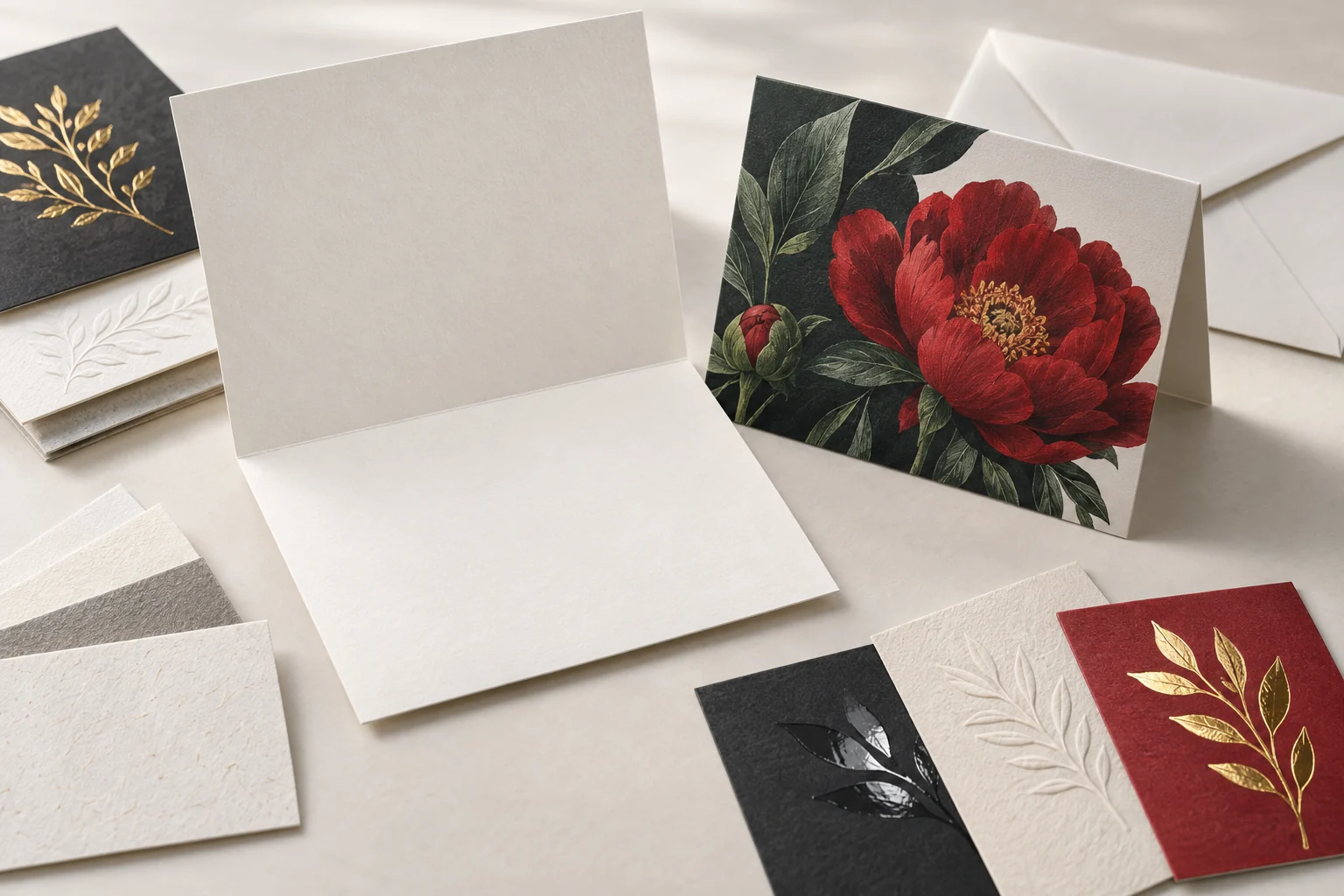
Short Answer
The best paper for a custom greeting card is the paper that fits the card’s artwork, hand feel, writing use, fold, envelope, packaging, price position, and production method. Do not choose from gsm alone.
For early planning, many folded greeting card projects discuss cover or cardstock options around 250-350 gsm. This is not a universal specification. Two papers with the same gsm can feel different because fiber, coating, bulk, caliper, texture, and stiffness are different. A physical sample is more useful than a weight number when tactile quality matters.
Use these starting points:
- Choose coated cardstock when image detail, smooth color, and a polished printed surface are the priority.
- Choose uncoated cardstock when natural texture, handwriting, and a softer stationery feel matter.
- Choose textured or specialty paper when the paper itself is part of the premium design, but test fine detail, solid ink coverage, folding, and finishing.
- Use matte, gloss, lamination, foil stamping, embossing, debossing, or spot UV only after confirming what the finish needs to achieve.
- Keep the inside uncoated or provide a tested writable area when customers will write on the card.
- Confirm scoring and grain direction for folded cards, especially with heavy paper, coated stocks, dark ink across the fold, or laminated surfaces.
The final quotation should identify the actual paper or approved equivalent, grammage or thickness, printing sides, coating or lamination, special process, envelope, quantity by design, packing, shipping terms, and destination.
Start with the Customer Experience
Paper selection should begin with how the buyer wants the finished card to look and feel, not with a material name copied from another quotation.
Ask:
- Is the card image-led, typography-led, illustrated, photographic, or mostly blank for handwriting?
- Should it feel natural, smooth, soft, glossy, textured, substantial, minimalist, or luxurious?
- Will the customer write with a ballpoint pen, gel pen, marker, pencil, fountain pen, or another tool?
- Does the inside need to remain blank and easy to write on?
- Will the card be sold individually, paired with one envelope, or packed as a 12-, 24-, 50-, or 100-card set?
- Is the product intended for an everyday stationery line, premium gift range, museum shop, artist collection, ecommerce insert, or promotional use?
- Does the artwork require foil, embossing, spot UV, edge treatment, die cutting, or another special process?
A paper that works for a photographic holiday card may not suit a handwritten thank-you card. A textured premium stock may support a simple foil design but reduce the sharpness of small printed details. Define the intended experience first.
GSM Is Not the Same as Thickness or Stiffness
Gsm means grams per square meter. It measures the mass of the paper, not its exact thickness, rigidity, opacity, or quality.
Two 300 gsm papers can have different caliper and stiffness. A bulky uncoated sheet may feel thicker than a denser coated sheet at the same gsm. Fiber composition, surface treatment, moisture, coating, and manufacturing method can all affect handling.
For quotation, send one of the following:
- A confirmed paper name, gsm, and supplier or mill reference.
- A physical reference sample that shows the desired stiffness and surface.
- A quality direction such as “natural writable card for an artist stationery line” and ask for supplier recommendations.
If a sample is important, confirm whether it uses the intended production paper or only a similar substitute. A digital sample on substitute stock can confirm layout and color direction but may not prove final paper feel, fold behavior, foil adhesion, emboss depth, or writing performance.
Coated vs Uncoated Greeting Card Paper
| Decision factor | Coated cardstock | Uncoated cardstock |
|---|---|---|
| Surface | Smooth, with a coated printing face | Natural, porous, or tactile |
| Image result | Often supports sharp detail and strong printed color | Can produce a softer, more organic appearance |
| Writing | Depends on coating; highly smooth or sealed areas may need testing | Often easier to write on, but ink behavior still varies |
| Hand feel | Polished, clean, commercial | Warm, stationery-like, tactile |
| Fingerprints and scuffing | Depends on coating, color, and finish | Depends on paper color and surface; uncoated solids may also mark |
| Folding | Coating and heavy ink at the fold may increase cracking risk | Still needs suitable grain direction and scoring |
| Common fit | Photography, saturated illustration, retail graphics | Handwritten cards, minimalist design, letterpress-style or natural ranges |
These are comparison tendencies, not guaranteed results. The print process, ink coverage, paper grade, scoring, coating, lamination, and artwork all affect the finished card.
Coated outside, writable inside
Some folded card projects need a polished exterior and a writable interior. This may be achieved through a paper choice, one-sided surface treatment, selective coating, or another production plan. Do not assume that every paper or process can provide a glossy front and fully writable inside without testing.
Describe which panels need coating and which areas need handwriting. If a coating, varnish, lamination, foil, or heavy ink crosses the fold, request a production review.
Textured and Specialty Papers
Textured, colored, pearlized, cotton-content, recycled-content, kraft-look, and other specialty papers can make the material part of the product design. They may suit premium stationery, artist cards, wedding-related cards, museum collections, and small gift lines.
They also require more checking:
- Fine type and thin lines may reproduce differently on a pronounced texture.
- Large solid ink areas may look less even on some uncoated or textured surfaces.
- White ink, metallic ink, or underprinting may be needed on dark or colored stock, depending on the design and process.
- Foil adhesion, embossing, coating, and lamination compatibility should be tested.
- Paper availability, minimum purchase, color consistency, and replacement stock can affect repeat orders.
- A special stock can change envelope matching, box dimensions, card-set weight, and shipping cost.
Do not select a specialty paper from a screen photo alone. Ask for a paper swatch or physical sample when color, texture, and stiffness are central to the product.
Choosing a Writable Inside Surface
If the customer will write inside the greeting card, define the writing requirement before approving the paper and finish.
An uncoated inside is often a practical starting direction, but “uncoated” does not guarantee identical performance with every pen. Surface sizing, texture, absorbency, ink type, drying time, and pressure can change the result. A rough paper may interrupt a fine pen line. A highly absorbent sheet may feather with some inks. A sealed or laminated surface may cause smearing or poor adhesion.
For projects where writing performance matters:
- List the intended writing tools.
- Keep critical writing areas free from lamination, foil, spot UV, and heavy varnish.
- Test representative pens on the actual or approved-equivalent paper.
- Check drying, smearing, show-through, feathering, and indentation.
- Confirm whether the card will be handwritten before or after folding and packing.
For ecommerce uses, read Thank You Card vs Package Insert. A flat insert that is fully preprinted may need a different surface from a folded card intended for handwritten notes.
Matte, Gloss, Varnish, and Lamination
Finish names can be ambiguous. A “matte card” might mean matte-coated paper, matte varnish, matte aqueous coating, matte lamination, or simply an uncoated sheet. Ask the supplier to state the actual construction.
Matte finish
A matte surface can reduce glare and support a restrained premium look. It does not automatically mean writable, fingerprint-proof, scratch-proof, or soft-touch. Confirm the finish type and intended handling.
Gloss finish
A gloss surface can increase shine and visual contrast for colorful artwork or photographs. It may be less suitable where handwriting is required. Dark glossy areas can show fingerprints or surface marks, so sampling and handling tests are useful.
Varnish or aqueous coating
These can provide surface protection and adjust gloss level without creating the same structure as film lamination. Suitability depends on the paper, printing method, desired appearance, rub resistance, fold, and production setup.
Film lamination
Matte or gloss lamination can add a film layer, change hand feel, and improve surface protection. It can also change fold behavior, recyclability considerations, writing performance, cost, and production requirements. Confirm whether lamination applies to one side, both sides, or selected panels.
Soft-touch surface
Soft-touch finishes can create a distinctive tactile result, but they should be evaluated for scuffing, marking, foil compatibility, fold performance, and repeat-order consistency. “Soft touch” may refer to different materials or processes, so request a defined sample.
Foil Stamping, Embossing, Debossing, and Spot UV
Special finishes should support the design rather than being added only because they sound premium.
| Finish | Visual or tactile role | Details to confirm |
|---|---|---|
| Foil stamping | Metallic, pigment, holographic, or contrasting highlight | Foil color, coverage, die, registration, paper compatibility, fold distance |
| Blind embossing | Raised paper without printed color or foil | Relief depth, reverse impression, stock thickness, artwork detail |
| Debossing | Recessed impression | Depth, reverse-side effect, paper and layout fit |
| Foil embossing | Foil plus raised impression | Whether one-step or separate processes are proposed; sampling |
| Spot UV | Gloss contrast on selected areas | Registration, line thickness, base surface, cracking and scuff risks |
| Die cutting | Custom outer shape or cut detail | Dieline, bridges, corners, strength, envelope and packing fit |
Foil stamping
Foil can emphasize a logo, greeting, border, or small illustration. Large solid foil areas, very fine lines, tight registration, textured paper, and foil close to a fold may require testing or artwork adjustment. Ask whether the foil die and setup are included in the quote and whether a repeat order can reuse the die.
Embossing and debossing
Embossing changes the paper structure. The reverse side can show an impression, which matters when the inside panel contains handwriting or printed text. Paper thickness, fiber, texture, artwork detail, die construction, pressure, and relief depth influence the result.
Spot UV
Spot UV creates a localized gloss or tactile contrast over selected artwork. Registration tolerance matters, especially around tiny text or narrow outlines. Confirm the base coating or lamination, minimum practical line and gap, and whether the finish crosses a score or fold.
All special finishes require project-specific quotation and may affect sampling and production time. South Print’s standard website reference prices do not include these processes unless separately quoted.
Folding, Scoring, and Grain Direction
A folded greeting card should be planned as a scored and folded product, not simply a flat printed sheet bent in half.
Paper fibers tend to align with the grain direction. Folds parallel to the grain are generally less prone to cracking than folds against the grain. Scoring is commonly used to create a controlled fold, especially for heavier, coated, laminated, or heavily printed stocks.
Fold quality can still be affected by:
- Paper grade, thickness, moisture, and grain direction.
- Score rule, channel, pressure, and fold direction.
- Coating or lamination.
- Heavy dark ink coverage across the fold.
- Foil, spot UV, or embossing positioned close to the score.
- Very small folded sizes or complex multi-fold structures.
Do not set one universal score width or grain rule in the artwork. The factory should confirm the production plan for the selected paper and layout. Review a physical sample when a clean dark fold or premium finish is critical.
Paper and Finish Affect Envelope and Set Packaging
Paper selection changes more than the card itself. A thicker or bulkier card changes the fit inside the envelope. Specialty finishes can require protective interleaving or another packing method. A 12-, 24-, 50-, or 100-card retail set can become materially thicker and heavier when paper, envelope, and finish change.
Confirm:
- Folded card size and open size.
- Card caliper or approved paper sample.
- Envelope internal fit, paper, color, flap, and printing.
- Cards and envelopes per set.
- Alternating, grouped, or collated design order.
- Belly band, sleeve, tuck box, two-piece box, or other retail package.
- Protection against foil rubbing, scuffing, or surface transfer.
- Export-carton dimensions and gross weight after packing.
See 4x6 vs 5x7 Greeting Card Printing for size, envelope, set packing, and reference-price comparisons.
FSC and Environmental Claims
If the product needs an FSC claim or on-product FSC label, state this before paper purchasing and artwork approval. A paper description containing “FSC” is not by itself permission to place an FSC trademark on the finished card.
FSC Chain of Custody requirements track eligible material through the supply chain. The certified product scope, material claim, supplier documentation, printer certification status, label artwork, approval process, and sales documents may all matter. Confirm the actual project and current trademark requirements before printing an FSC label or claim.
For recycled content, plastic-free construction, recyclability, compostability, or other environmental messaging, request evidence that supports the exact claim. Lamination, foil, adhesives, envelopes, windows, boxes, and mixed components can change the construction. Avoid broad claims such as “eco-friendly” without a defined basis.
How Paper and Finishes Change the Quote
The final cost can change through:
- Paper price, sheet size, availability, and minimum purchase.
- Printing setup and ink coverage.
- Scoring, folding, and drying or curing requirements.
- Film lamination, coating, foil dies, embossing dies, and spot processes.
- Additional make-ready, testing, inspection, and spoilage allowance.
- Multiple designs or languages at a low quantity per design.
- Envelope paper, color, printing, and matching.
- Protective packing and retail set assembly.
- Carton volume, weight, shipping term, and destination.
South Print’s current reference prices for standard folded 4 x 6 and 5 x 7 cards are planning references for one folded greeting card plus one unprinted blank envelope. They are not fixed offers and do not include special finishes, printed envelopes, custom retail boxes, or shipping unless those items are quoted separately.
What to Send for a Paper and Finish Recommendation
Send:
- Folded finished size and flat open size.
- Quantity per design and total number of designs.
- Front, inside, and back artwork preview.
- Intended hand feel and retail position.
- Whether the inside must be writable and which writing tools are expected.
- Known paper name, gsm, thickness, or physical reference sample.
- Coated, uncoated, textured, colored, recycled-content, or other paper direction.
- Matte, gloss, lamination, foil, embossing, debossing, spot UV, or die-cut requirements.
- Envelope specification and cards per retail set.
- Packing, destination, shipping terms, and target timing.
- FSC or other documented sourcing and claim requirements.
If the material is not decided, send reference photos and describe the desired result. Ask the supplier to quote a practical standard option and a premium alternative on the same size, quantity, envelope, packing, and shipping assumptions.
For the full inquiry list, use What Information Should You Send for a Custom Paper Product Quote?.
Practical Recommendation
Choose paper in this order:
- Define the end customer’s visual, tactile, and writing experience.
- Confirm the card size, fold, envelope, and retail-set structure.
- Compare paper samples by surface, stiffness, opacity, thickness, and print fit, not gsm alone.
- Add only the finishes that improve the design or product positioning.
- Review scoring, grain direction, artwork coverage, and special-process compatibility.
- Approve a physical sample when paper feel, writing, fold quality, foil, embossing, or color is commercially important.
- Reconfirm the quotation, packing, carton data, and production schedule after the final construction is approved.
Review South Print’s custom greeting card printing and thank you insert card printing, or visit the South Print blog for more B2B printing guides.
FAQ
What paper weight is best for custom greeting cards?
There is no universal best weight. Many folded card projects discuss cardstock around 250-350 gsm for early planning, but gsm does not define exact thickness or stiffness. Choose from the artwork, writing use, fold, envelope, finish, retail position, and a physical sample or approved material specification.
Is coated or uncoated paper better for greeting cards?
Coated paper can suit detailed images, smooth color, and a polished exterior. Uncoated paper can suit handwriting, natural texture, and a stationery feel. A project may also combine a polished outside direction with a tested writable inside. The final choice should be sampled with the actual artwork and finish.
Can customers write on a matte laminated greeting card?
Do not assume so. Matte lamination is not the same as uncoated paper, and writing performance varies by film, pen, pressure, and drying time. Keep the writing area unlaminated or test the intended pens on the actual surface before production.
Does a folded greeting card need scoring?
Scoring is commonly used to create a controlled fold, especially for cover-weight, coated, laminated, or heavily printed paper. Grain direction, paper, thickness, artwork coverage, coating, and production equipment affect the result, so the scoring plan should be confirmed for the selected material.
Are foil stamping and embossing included in South Print’s reference prices?
No. South Print’s standard 4 x 6 and 5 x 7 folded greeting card reference prices are planning references for one folded card plus one unprinted blank envelope. Foil, embossing, debossing, spot UV, specialty paper, printed envelopes, custom retail packaging, and shipping should be quoted separately when required.
Can I print an FSC logo on custom greeting cards?
Only when the project follows the applicable FSC Chain of Custody and trademark requirements. Confirm eligible material, the certified supply chain, printer scope, correct claim, label artwork, approval, and documentation before printing an FSC logo or making an FSC claim.