Short Answer
Custom jigsaw puzzle printing cost depends mainly on piece count, finished puzzle size, board thickness, box structure, order quantity, number of artwork designs, and shipping method. For standard existing-die puzzle formats with basic retail box and packing, South Print's current reference pricing starts around the following levels before final project confirmation:
| Puzzle format | 100 sets | 500 sets | 2,000 sets |
|---|---|---|---|
| 1000 pcs, 750 x 500 mm | About USD 4.50/set | About USD 2.50/set | About USD 1.80/set |
| 500 pcs, 610 x 457 mm | About USD 3.60/set | About USD 2.00/set | About USD 1.70/set |
| 100 pcs, 495 x 355 mm | About USD 2.90/set | About USD 1.50/set | About USD 1.20/set |
These are reference prices for comparison, not a fixed offer for every project. They exclude final shipping, import duty or tax, new tooling, special finishes, and nonstandard packaging unless those items are quoted separately. Final pricing should be confirmed after checking the artwork, packaging, quantity by design, production requirements, and delivery terms.
What Is Included in a Typical Custom Puzzle Quote?
A custom jigsaw puzzle quote should clearly state whether it covers the printed puzzle, greyboard or puzzle board, die cutting, puzzle breaking, basic packing, and the printed retail box if the buyer requests a boxed puzzle set. For retail products, the box is not a small detail. It affects paper use, printing plates, lamination, handwork, carton volume, and shipping weight.
For standard projects, buyers often ask for:
- A 100 piece, 500 piece, or 1000 piece puzzle.
- Full-color puzzle artwork.
- A printed box with front, back, and side panels.
- Shrink wrap or other retail-ready packing.
- Export cartons for international shipping.
Some projects also need an insert sheet, barcode placement, warning text, FSC paper request, special coating, a custom box structure, or a new puzzle die. Each added requirement can change the final quotation.
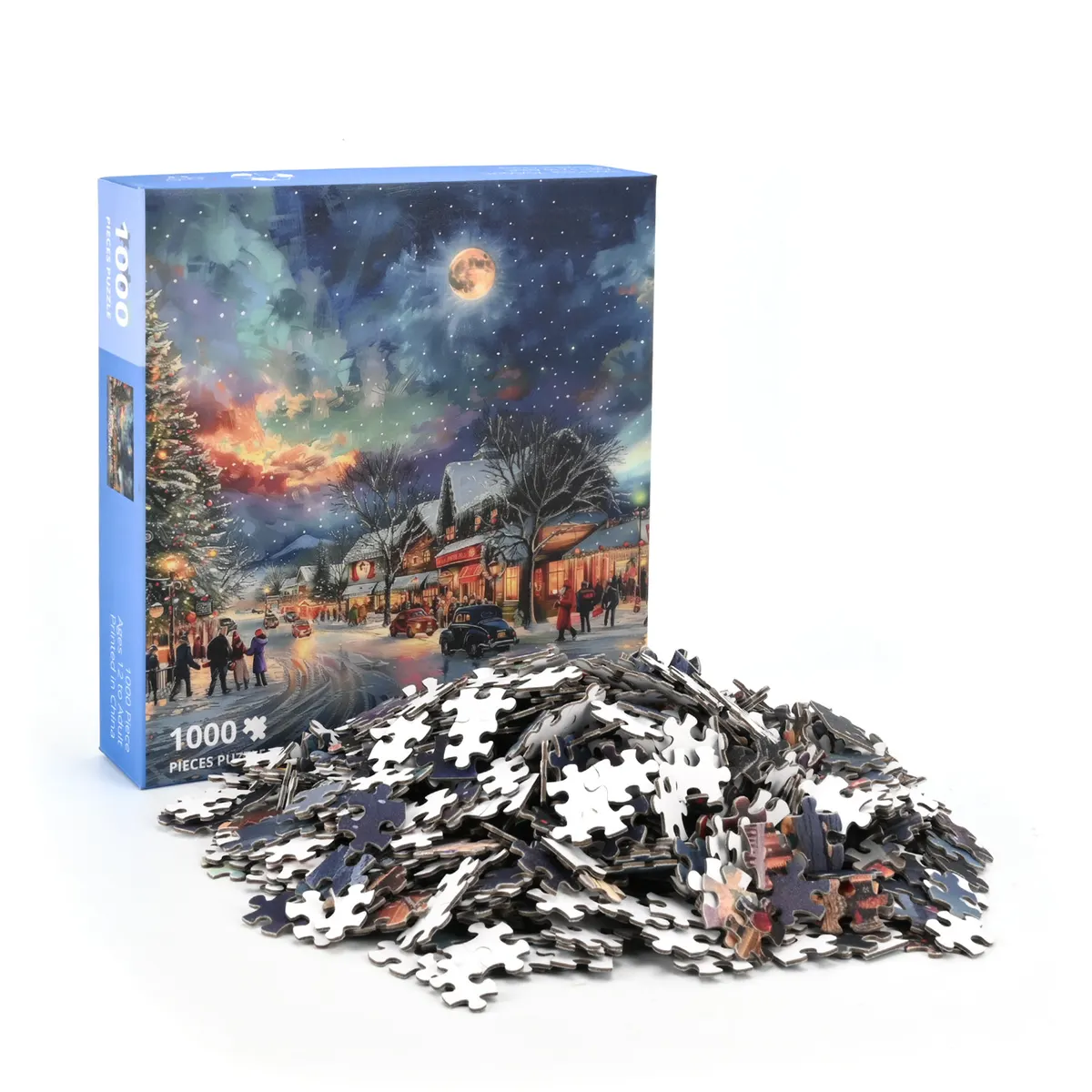
For the standard product options, see South Print's custom jigsaw puzzle printing page. For a typical retail format, see the 1000 piece puzzle set case.
Why Does Piece Count Change the Price?
Piece count affects both material use and converting work. A 1000 piece puzzle usually needs a larger finished size, larger printed sheet, stronger board, a more complex cutting die, and more handling than a small 100 piece puzzle.
However, the highest piece count is not always the most expensive in the way buyers expect. Unit cost is also affected by:
- Whether the factory already has a matching puzzle die.
- Whether the finished size fits efficiently on available paper sheets.
- Whether the box is a standard size or a custom structure.
- Whether the same design is ordered in one large quantity or split into many small designs.
- Whether packing is simple bulk carton packing or retail-ready individual packing.
This is why two buyers can both ask for a "500 piece custom puzzle" and receive different prices.
Existing Die or New Die: Why It Matters
Using an existing puzzle die can reduce setup cost and make sampling easier, especially for standard puzzle formats. South Print commonly works with standard adult puzzle sizes such as 1000 pieces at 750 x 500 mm, 500 pieces at 610 x 457 mm, and 100 pieces at 495 x 355 mm. Existing die availability and fit should still be confirmed against the final artwork, finished size, and production schedule before quotation or sampling.
If a buyer needs a custom shape, unusual finished size, special piece shape, magnetic puzzle, very large format, or children's puzzle with a different piece layout, a new die may be needed. A new die can add tooling cost and may require more checking before production.
For a first order, many small brands choose a standard size first. After the product proves demand, they may develop custom sizes or special packaging for later orders.
How Order Quantity Affects Unit Price
The same puzzle can have a much higher unit price at 100 sets than at 500 or 2,000 sets. This is normal in print manufacturing because setup work is shared across the order.
Setup-related costs may include:
- File checking and prepress.
- Printing setup.
- Cutting setup.
- Box production setup.
- Packing preparation.
- Production management and quality checks.
When quantity increases, these costs are spread across more units. Material purchasing and production scheduling may also become more efficient. This is why unit price usually improves as quantity increases, but it does not always drop in a straight line.
For buyers testing a new design, a smaller first order can reduce inventory risk. For repeat sellers, a larger order often gives a better landed cost per set.
Packaging Can Change the Quote More Than Buyers Expect
Many buyers compare puzzle prices by piece count only, but packaging can be one of the biggest cost variables.
A simple custom puzzle set may use a standard two-piece printed box. A more complex retail product may require:
- A thicker paperboard box.
- Matte or gloss lamination.
- Spot UV, foil stamping, embossing, or other surface finishing.
- An insert sheet or instruction sheet.
- Inner bag packing.
- Shrink wrap.
- Custom carton packing by SKU.
These details affect material cost, production time, labor, and shipping volume. If you are comparing quotes from multiple suppliers, make sure each supplier is quoting the same box structure, material, finish, and packing method.
Foil stamping, spot UV, embossing, and other special finishes should be quoted separately from the basic puzzle and box price.
Number of Designs Matters
A quote for 1,000 sets of one design is different from a quote for 1,000 sets split across ten designs. More designs can mean more file checking, more printing setup, more sorting, more packing labels, and more chance of production complexity.
When requesting a quote, write the quantity by design clearly. For example:
- 500 sets total, 1 design.
- 1,000 sets total, 4 designs, 250 sets per design.
- 2,000 sets total, 10 designs, 200 sets per design.
This helps the factory quote more accurately and avoids price changes later.
Shipping and Trade Terms Affect the Real Cost
The product unit price is not the same as the landed cost. Puzzle sets can be bulky and heavy, especially when packed in retail boxes. The final cost to the buyer may depend on whether the quote is EXW, FOB, CIF, DDP, or another trade term.
For early comparison, ask the supplier to state what is included:
- Product only.
- Product plus export carton packing.
- Product plus FOB port charges.
- Product plus estimated shipping.
- Product plus delivery to a specific address, if available.
Door-to-door shipping and duty-paid service may be available for some routes, but it should not be assumed for every country, product, or order size. Confirm the destination country, postal code, delivery address type, and import requirements before treating any shipping estimate as final.
What Should Buyers Send for an Accurate Quote?
To get a useful quotation, send more than "How much for a custom puzzle?" A practical RFQ should include:
- Finished puzzle size.
- Piece count, such as 100, 500, or 1000 pieces.
- Order quantity and quantity by design.
- Puzzle artwork and box artwork, or at least a design preview.
- Box style and whether shrink wrap is needed.
- Board thickness or expected quality level, if known.
- Whether an insert sheet, barcode, warning text, or certification request is needed.
- Delivery country and preferred trade term.
- Target selling channel, such as Amazon, Shopify, museum shop, retail store, or promotional gift.
If you are not sure about the exact specification, send your target retail price, selling channel, and reference product photos. A factory can usually suggest a practical specification for sampling.
Cost Comparison: 100, 500, and 1000 Piece Puzzles
100 Piece Puzzle
A 100 piece puzzle is suitable for kids products, small gifts, promotional products, and lower-price retail items. It usually has a smaller finished size, easier handling, and lower perceived difficulty for the end customer.
It can be a good starting point when the buyer wants a compact product or a lower first-order budget.
500 Piece Puzzle
A 500 piece puzzle is often a middle option for artists, gift brands, and ecommerce sellers. It feels more substantial than a small gift puzzle but is usually easier to complete than a 1000 piece adult puzzle.
It can work well for image-led products, seasonal designs, and retail sets where buyers want a balance between price, shelf appeal, and user experience.
1000 Piece Puzzle
A 1000 piece puzzle is a common adult retail format for museum shops, illustration products, tourism gifts, and premium ecommerce puzzle lines. It gives more space for detailed artwork and often feels more valuable to the end customer.
It may require a stronger packaging plan because the finished product is larger and heavier. Artwork quality also matters more because details are more visible.
Common Reasons a Puzzle Quote Changes After the First Estimate
A first estimate may change when the factory receives complete files or updated requirements. Common reasons include:
- The artwork size does not match an existing die.
- The buyer changes from a standard box to a custom box.
- The number of designs increases.
- The buyer adds foil stamping, spot UV, or other finishing.
- The order quantity changes by design.
- The delivery country or shipping method changes.
- Retail compliance text, barcode, or packaging labels are added late.
To avoid delays, confirm the puzzle specification and packaging before sample production.
Practical Recommendation
For a first custom jigsaw puzzle order, start with a standard existing die, a clear retail box structure, and one or a small number of designs. This makes the quote easier to compare and reduces unnecessary setup cost.
If you are preparing a custom puzzle project, send South Print the piece count, finished size, artwork preview, box requirement, quantity by design, and delivery country. You can contact the team at sales@southprintcn.com or by WhatsApp.
For more buying guides, visit South Print's blog.
FAQ
Is custom jigsaw puzzle printing cheaper at higher quantities?
Usually, yes. Setup costs are spread across more units, and production can become more efficient. The exact price drop depends on size, piece count, packaging, number of designs, and shipping requirements.
Does a 1000 piece puzzle always cost more than a 500 piece puzzle?
Usually it costs more because it uses more material and needs more production handling, but the final comparison depends on the size, packaging, quantity, and whether existing dies are used.
Can I print several puzzle designs in one order?
Yes, but the quote should show quantity by design. Ten designs at 100 sets each is not the same production plan as one design at 1,000 sets.
Do I need finished artwork before asking for a price?
You can ask for a reference estimate with size, piece count, quantity, and packaging details. For a final quote and sample, print-ready puzzle artwork and box artwork are normally needed.
Is shipping included in the puzzle unit price?
Not always. Ask whether the quote is EXW, FOB, CIF, DDP, or another term. Shipping cost depends on carton volume, weight, destination, and delivery method.