Short Answer
A 100 piece puzzle can suit compact gifts, educational products, branded activities, and buyers who want larger pieces. A 500 piece puzzle is a flexible middle format for artwork, gift shops, family activities, and ecommerce. A 1000 piece puzzle is a familiar adult retail format for detailed artwork and a longer assembly experience.
Finished size matters as much as piece count. Two puzzles with the same number of pieces can have different average piece sizes, shelf presence, box requirements, shipping volume, and user experience. Before requesting a quote, define the target user, finished puzzle size, piece count, artwork ratio, packaging, quantity by design, and destination.
| Format | Common South Print size | Typical direction | Packaging direction |
|---|---|---|---|
| 100 pieces | 495 x 355 mm | Compact retail, gift, education and promotional formats | Printed box, sleeve or compact retail pack |
| 500 pieces | 610 x 457 mm | Art, museum, family, gift and ecommerce puzzle lines | Printed retail box; poster or insert optional |
| 1000 pieces | 750 x 500 mm | Detailed artwork, adult retail, museum and premium ecommerce | Stronger retail presentation and careful carton planning |
These are standard planning references, not universal dimensions. Existing die fit, board thickness, artwork orientation, packaging, quantity, and production availability should be confirmed before quotation or sampling.
Piece Count Is Not the Same as Difficulty
The assembly experience also depends on finished size, average piece size, artwork, color variation, repeated patterns, cut layout, and whether a reference image is supplied. A large 500 piece puzzle may have larger pieces than a compact 500 piece puzzle. A detailed night scene can also feel harder than a bright illustration with clear color areas.
Discuss piece count together with finished dimensions, intended handling, artwork ratio, board thickness, surface finish, die availability, box size, inner packing, selling channel, and retail price position.
For products intended for children, the buyer should define the target market, age grading, piece dimensions, warnings, testing, and compliance requirements. These requirements should not be inferred from piece count alone.
Small and Educational Puzzle Options
Not every project should start at 100 pieces. Small-format puzzles can work for learning products, classroom activities, promotional gifts, travel products, coloring puzzle sets, museum activities, and educational kits.
Existing small puzzle die options that South Print can discuss include planning examples such as 9 x 9 cm with 16 pieces, 10 x 10 cm with 9 pieces, 11 x 6 cm with 8 pieces, 11 x 11 cm with 12 pieces, 12 x 12 cm with 36 pieces, A6 at 10.5 x 15 cm with 40 pieces, 15 x 15 cm formats with 16, 24, or 36 pieces, and 19 x 19 cm formats with 6, 12, 18, or 24 pieces.
Final fit and availability still need confirmation against artwork ratio, board, piece layout, quantity, packaging, target market, and production schedule. Packaging may use a paperboard box, sleeve, bag, header card, backing board, or placement inside a larger kit.
Choosing a 100 Piece Puzzle
A 100 piece puzzle can provide a complete retail experience without the longer assembly time of a 500 or 1000 piece format. It can support image-led gifts, tourism products, museum activities, school projects, promotional campaigns, artist merchandise, and compact ecommerce products.
South Print's common 100 piece reference is 495 x 355 mm. Planning examples of other existing formats may include square, compact, panoramic, and alternative rectangular dies such as 35.1 x 35.1 cm, 35.5 x 49.5 cm, 22 x 22 cm, and 61 x 23.9 cm. The actual die must be confirmed for quotation or sampling.
Consider this direction when the image benefits from larger visible areas per piece, the product should be approachable without a long assembly session, or the buyer wants a compact gift or activity product. The package still needs enough internal space for loose pieces, inner packing, instructions, or a promotional insert.
Choosing a 500 Piece Puzzle
A 500 piece puzzle is a practical middle format for artists, museum stores, gift brands, tourism products, seasonal collections, family activities, and ecommerce sellers. It provides a substantial assembly experience while remaining more compact than many 1000 piece formats.
South Print's common reference is 610 x 457 mm. Other planning examples may include rectangular, square, circular, and heart-shaped dies such as 68.5 x 54.8 cm, 45.7 x 45.7 cm, 61 x 61 cm heart shape, 50.8 x 50.8 cm circle, 70 x 35.6 cm, and 75 x 50 cm. Tooling fit and production availability require confirmation.
A printed two-piece box is a common retail direction. Depending on the project, the set may also include an inner bag, shrink wrap, reference poster, instruction sheet, barcode, SKU, artist story, or museum information. Each component changes box size, assembly work, carton volume, and quotation.
Choosing a 1000 Piece Puzzle
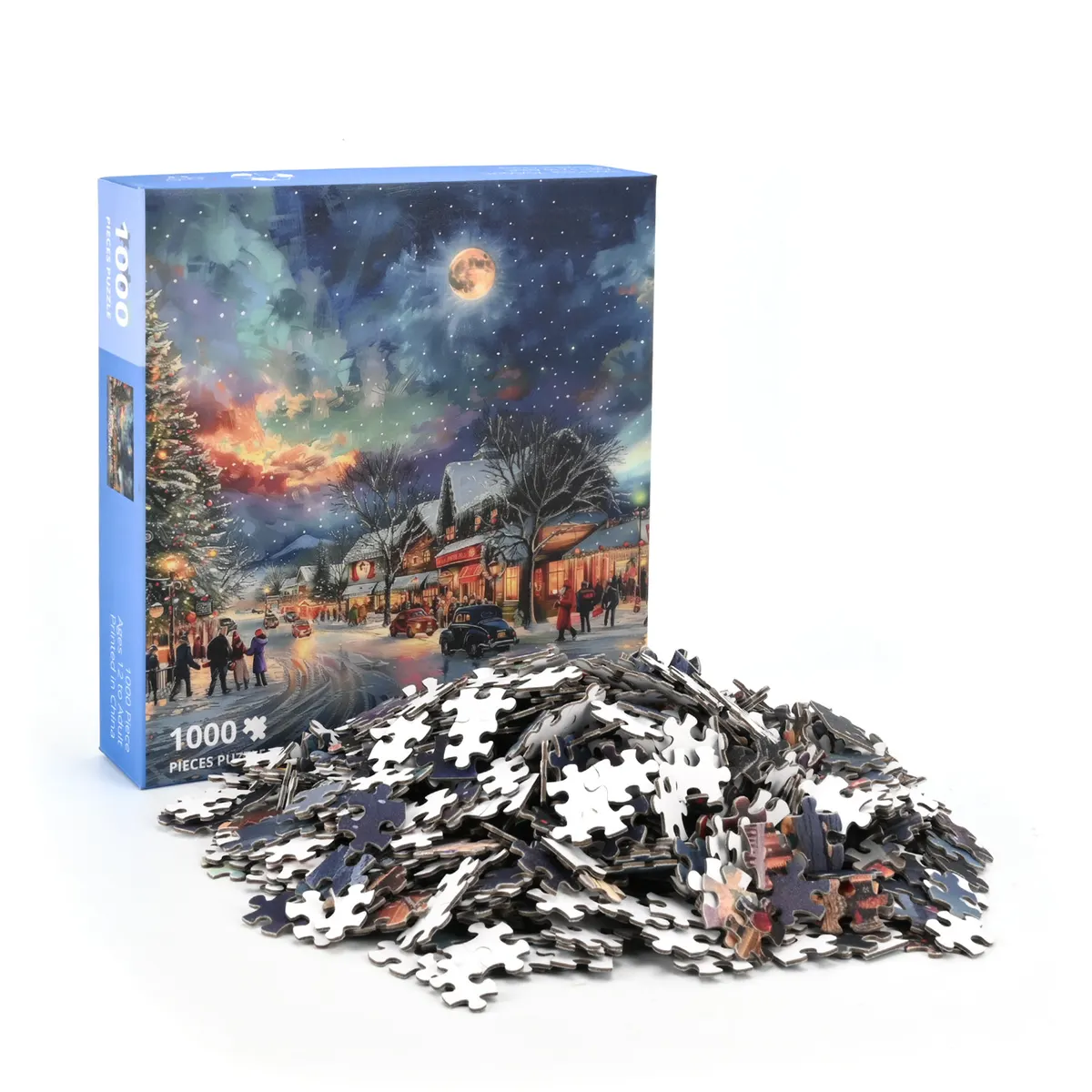
A 1000 piece puzzle is a familiar adult retail format and can give detailed artwork a stronger premium presence. It is commonly considered for museum collections, illustration products, destination artwork, photography, licensed art, gift shops, and established ecommerce puzzle lines.
South Print's common format is 750 x 500 mm, with A/B die versions that should be confirmed for the actual order. The image ratio should be checked before artwork is finalized. Cropping a portrait, panoramic, or edge-sensitive design into a 3:2 format can remove important details.
This direction works best when the artwork contains enough detail and variation, the customer expects an adult retail puzzle, and the sales channel can support a larger and heavier boxed product. Packaging often needs a large reference image, piece count, finished size, brand or artist information, barcode, and market-specific copy.
Compare the Formats
| Decision factor | 100 pieces | 500 pieces | 1000 pieces |
|---|---|---|---|
| Assembly experience | Shorter and approachable | Medium-length, flexible retail format | Longer adult-oriented experience |
| Common reference size | 495 x 355 mm | 610 x 457 mm | 750 x 500 mm |
| Artwork direction | Bold illustration, education, gift or promotion | Art, family, museum, gift and ecommerce | Detailed illustration, photography, museum and premium retail |
| Packaging demand | Compact box, sleeve or retail pack | Printed retail box, optional insert or poster | Strong printed box and careful inner/carton packing |
Existing Dies Can Simplify a First Project
An existing die can reduce the need for new tooling and make a standard project easier to quote and sample. It should not be selected only because its piece count matches the product idea. Confirm the exact size, piece layout, artwork ratio, board construction, die shape, current tooling condition, production availability, and packing requirements.
South Print can also discuss double-layer framed puzzle planning examples around 15 x 20 cm with 16 pieces, 18.5 x 22.5 cm with 40 pieces, 30 x 22.4 cm with 60 pieces, 37 x 29 cm with 72 pieces, and 19 x 19 cm with 25 inner pieces. Tooling fit, frame structure, board construction, artwork, packaging, and production availability must be confirmed before quotation.
For dielines and image preparation, read How to Prepare Artwork for Custom Jigsaw Puzzle Printing.
Match Packaging to the Selling Channel
Printed two-piece box
A lid-and-base printed box is a familiar retail direction for 500 and 1000 piece puzzles and can also support smaller premium sets. It provides space for a reference image, product information, barcode, brand story, and side-panel text.
Paperboard box or tuck-style pack
A lighter paperboard box may suit compact puzzles, promotional products, and educational sets when the stack height and product weight allow it. The dieline needs enough depth and closure strength for the actual pieces.
Sleeve, bag, or header-card direction
A sleeve or bag-based pack can reduce package weight for compact activity products. It provides less protection and printable space, so confirm how pieces are contained and where instructions, barcode, warnings, and branding will appear.
Inserts and reference images
A poster, instruction sheet, reference card, or printed insert can improve the user experience, but it adds paper, assembly, box depth, and packing work. State the insert size, folding method, and printing sides in the RFQ.
Shipping cartons
Retail box size affects how many sets fit in an export carton and how much shipment volume is required. Compare suppliers using the same retail box, inner packing, export carton assumptions, shipping term, and destination.
Check Artwork Ratio Before Choosing the Die
A 750 x 500 mm puzzle uses a 3:2 proportion, while square, panoramic, and other rectangular dies need different artwork ratios. Place the artwork inside the proposed ratio, check important content near the edges, confirm whether cropping is acceptable, and avoid stretching the image.
If the image does not suit the first die, choose another confirmed standard or specialty format, extend the background carefully, revise the composition, or discuss a custom die.
What to Send for a Recommendation and Quote
- Intended product use, target customer, selling channel, and target market.
- Artwork preview, image ratio, preferred piece count, and finished footprint.
- Quantity by design and board quality target, if known.
- Box style, inner packing, insert, poster, shrink wrap, and barcode needs.
- Whether an existing die is preferred.
- Destination country, shipping term if known, and target launch timing.
For a broader checklist, read What Information Should You Send for a Custom Paper Product Quote?.
Practical Recommendation
For a first retail puzzle, begin with the customer experience and artwork. Choose the approximate assembly length, finished footprint, and selling channel, then compare the artwork ratio against confirmed existing dies. A standard 100, 500, or 1000 piece format can simplify the first quote, but a small educational, panoramic, circular, heart-shaped, or framed puzzle may fit the concept better.
Do not compare piece count without comparing finished size and packaging. Ask suppliers to quote the same puzzle dimensions, board, box, inner packing, quantity by design, shipping term, and destination.
Review South Print's custom jigsaw puzzle printing options, 1000 piece retail puzzle case, and puzzle printing cost guide. For more sourcing guides, visit the South Print blog.
FAQ
Is a 500 piece puzzle always smaller than a 1000 piece puzzle?
Often, but not always. Finished size and average piece size vary by die and manufacturer. Confirm both the piece count and exact finished dimensions before comparing products or quotations.
What finished sizes does South Print commonly use for 100, 500, and 1000 piece puzzles?
Common planning references are 495 x 355 mm for 100 pieces, 610 x 457 mm for 500 pieces, and 750 x 500 mm for 1000 pieces. Existing die fit and production availability should be confirmed for each project.
Does a higher piece count automatically make a better retail puzzle?
No. The right format depends on the target user, artwork, assembly experience, finished footprint, packaging, selling channel, and price position. A well-planned 100 or 500 piece puzzle may suit the product better than a 1000 piece format.
Can South Print use an existing die for a custom puzzle?
Possibly. South Print can review existing puzzle die options, but fit and availability must be confirmed against the final size, piece layout, artwork orientation, board, quantity, packaging, and production schedule.
What packaging is common for custom retail puzzles?
Options can include printed two-piece boxes, paperboard boxes, sleeves, bags or header-card packs, inner bags, shrink wrap, posters, and instruction inserts. The best structure depends on puzzle size, piece count, retail positioning, protection needs, and shipping plan.
What information should I send if I do not know which piece count to choose?
Send the artwork preview, intended customer, product use, selling channel, target market, preferred finished footprint, quantity by design, packaging direction, destination, and any reference product photos. South Print can then review which existing formats may be practical for quotation or sampling.