Short Answer
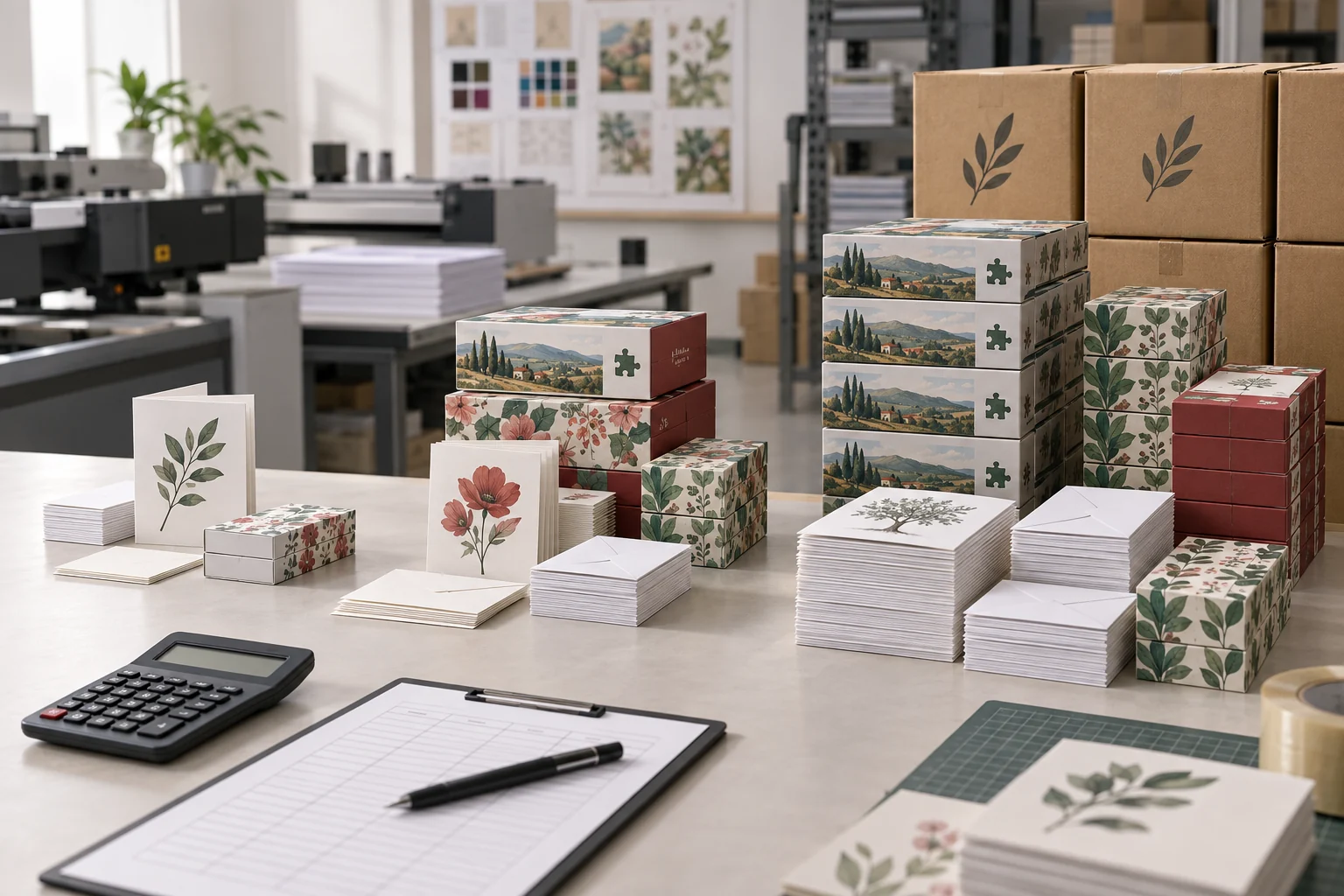
Custom printing unit prices often fall as order quantity increases because setup work is distributed across more sellable units. File checking, machine preparation, printing setup, cutting or die-cutting setup, finishing setup, packing preparation and quality control are needed even for a relatively small order. At 200 units, each product carries a larger share of those costs. At 500 or 2,000 units, the same or similar setup work is spread across more units.
The price does not normally fall in a straight line. Material purchasing, sheet utilization, machine choice, number of designs, packaging, finishing and production efficiency can create larger savings at one quantity break and smaller savings at another.
The lowest unit price is not automatically the best buying decision. A larger order also uses more cash, storage space and shipping capacity, and it creates more inventory risk. Buyers should compare:
- Unit price for the same confirmed specification.
- Total order value.
- Quantity per design, not only total quantity.
- Packaging and assembly scope.
- Freight, duty, tax and delivery scope.
- Expected sales rate and inventory holding risk.
South Print’s 200, 500 and 2,000 quantity levels are useful reference points for several card products. Puzzle references commonly use 100, 500 and 2,000 sets instead. These are planning levels, not universal minimum order quantities or fixed offers.
What Is Inside a Custom Printing Unit Price?
A custom printed product is not priced from paper alone. A quotation may combine three broad cost types.
| Cost type | Examples | What quantity changes |
|---|---|---|
| Setup-related | File review, prepress, machine setup, color setup, cutting setup, packing preparation | Shared across more units as quantity increases |
| Unit-related | Paper, board, ink, envelopes, boxes, bags, labels and direct processing | Usually increases with every additional unit |
| Step or batch-related | Additional print forms, foil or embossing dies, new tooling, extra design changes, carton labels, inspection or assembly batches | May increase when a quantity or design threshold is crossed |
This is why a buyer cannot reliably estimate 2,000-unit pricing by multiplying a 200-unit quote, or estimate 200-unit pricing by dividing a 2,000-unit quote.
Production technology also matters. A printer may use different equipment or impose a different sheet plan for a short run and a longer run. The most efficient production route depends on the finished size, sheet layout, paper, color, finishing, packaging and schedule. Buyers do not need to select the press themselves, but they should keep the product specification consistent when comparing quantity options.
Why the First Quantity Tier Often Has the Highest Unit Price
Before sellable products are produced, the factory may need to:
- Review artwork and confirm the finished size.
- Prepare or check dielines.
- Arrange paper, board and packaging materials.
- Set up printing and achieve an approved production result.
- Set up scoring, folding, die cutting, corner rounding or puzzle cutting.
- Prepare foil, embossing, spot UV or other special processes when required.
- Establish sorting, collation and packing instructions.
- Prepare inspection standards and carton marks.
These activities consume labor, machine capacity, material and management time. In printing, this preparation is often called makeready. Shorter makeready time and lower setup waste can improve production cost efficiency, but every custom job still needs preparation before sellable units are produced.
At a low quantity, setup cost is divided by a small number of finished products. A short run may also leave less room to optimize material purchasing or production scheduling. This does not mean the factory is charging a penalty for small buyers. It reflects that a custom job still needs to be prepared and controlled.
Why the Price Drop Is Not Linear
If the quantity increases from 200 to 500, it does not follow that the unit price must fall by exactly 60 percent. If it increases from 500 to 2,000, the price may improve again, but not at the same rate.
Several reasons explain the uneven curve:
- Some setup costs are mostly paid once per job.
- Paper, board, envelopes and packaging still have a cost for every unit.
- Material suppliers may offer more efficient purchasing quantities at certain levels.
- A different sheet layout or production method may become practical at a higher quantity.
- Finishing and assembly can remain labor-intensive even when printing becomes more efficient.
- Additional cartons, pallets, warehouse handling or delivery requirements appear as volume grows.
- Very high quantities can require split production, additional quality checks or a longer schedule.
The correct question is not “What percentage discount do I receive?” It is “What production and packing assumptions are included at each quantity?”
South Print Reference Quantity Examples
The following examples show how strongly quantity can affect a planning unit price. They are website references, not final quotations.
| Product reference | First level | 500 level | 2,000 level |
|---|---|---|---|
| 4 x 6 in folded greeting card + one unprinted blank envelope | 200 cards: about USD 0.54/card | About USD 0.16/card | About USD 0.10/card |
| 5 x 7 in folded greeting card + one unprinted blank envelope | 200 cards: about USD 0.65/card | About USD 0.25/card | About USD 0.14/card |
| Standard Flash Card reference, 36-64 cards/set, cardstock box | 200 sets: about USD 2.15/set | About USD 1.20/set | About USD 0.80/set |
| Flat business-card-size thank you insert card | 200 cards: about USD 0.20/card | About USD 0.15/card | About USD 0.10/card |
| 1,000-piece puzzle, 750 x 500 mm | 100 sets: about USD 4.50/set | About USD 2.50/set | About USD 1.80/set |
| 500-piece puzzle, 610 x 457 mm | 100 sets: about USD 3.60/set | About USD 2.00/set | About USD 1.70/set |
| 100-piece puzzle, 495 x 355 mm | 100 sets: about USD 2.90/set | About USD 1.50/set | About USD 1.20/set |
These references do not share one universal specification. The greeting card references include one folded card and one unprinted blank envelope. The Flash Card reference applies to a standard 36-64 card deck with a cardstock box; it should not be applied to Memory Card matching games or other card decks without checking the actual structure. The flat insert does not include an envelope or folded construction. Puzzle formats use different finished sizes, piece counts, board, cutting and packaging requirements.
Special finishes, printed envelopes, nonstandard materials, custom retail packaging, new tooling, freight, duty and tax are not included unless the quotation states otherwise. Review the relevant product guide before using any figure in a budget:
- Custom jigsaw puzzle printing cost
- 4x6 vs 5x7 greeting card printing
- Memory Cards vs Flash Cards for custom printing
Total Quantity Is Not the Same as Quantity per Design
One of the most common quote comparison mistakes is giving only the total quantity.
Consider two greeting card inquiries:
- 2,000 cards with one design.
- 2,000 cards divided across 20 designs, with 100 cards per design.
The total number of cards is identical, but the second order may require more file checking, print changes, sorting, identification and packing control. It may not qualify for the same unit price as one design at 2,000 cards.
The same principle applies to puzzles and card decks:
- 1,000 puzzle sets with one puzzle and box design.
- 1,000 puzzle sets divided across four designs at 250 sets each.
- 2,000 Flash Card sets with one complete deck design.
- 2,000 card sets divided across ten different deck products at 200 sets each.
Some designs may be combined efficiently on a production sheet, but buyers should not assume that unrelated designs can always share setup costs. Finished size, paper, printing sides, color, finish, cutting, box structure and delivery schedule must be compatible. Always request the quantity per design and total quantity as separate lines in the quotation.
Packaging Can Limit the Unit-Price Reduction
Printing can become more efficient at higher quantities while packaging and assembly remain relatively labor-intensive.
Examples include:
- Matching each greeting card with the correct envelope.
- Collating 12, 24, 50 or 100 cards into a retail set.
- Sorting multiple designs in a specified sequence.
- Packing a Flash Card deck into a cardstock box with instructions.
- Placing puzzle pieces into an inner bag and matching them to the correct box.
- Applying barcodes, SKU labels or fulfillment labels.
- Shrink wrapping or adding protective paper between finished surfaces.
If one quote includes retail-ready assembly and another includes bulk components, their unit prices are not comparable. Ask suppliers to separate product printing, retail packaging, assembly and export-carton packing where useful.
MOQ and Price Break Are Different
MOQ means minimum order quantity. A price break is a quantity where the unit price changes. They are related, but they are not the same.
A supplier may be able to produce below a displayed reference quantity but quote a higher unit price, recommend a different process, or require a minimum material purchase. Another project may need a higher practical minimum because of custom paper, envelopes, tooling, foil, packaging or multiple designs.
Therefore, 200, 500 and 2,000 units should be treated as comparison points for the relevant South Print references, not as a promise that every custom paper product has a 200-unit MOQ.
When your target quantity is between the displayed levels, ask for the actual quantity. It can also be useful to request two or three options, for example:
- Target test quantity.
- Likely reorder quantity.
- Quantity needed for a lower target landed cost.
When a Small Test Order Is the Better Decision
A 200-unit order may have a higher unit price but still be the better commercial decision when:
- The product or artwork has not been tested in the market.
- The buyer wants to confirm customer response before holding inventory.
- Packaging or product copy may change.
- The sales channel, barcode, instructions or compliance content is still developing.
- Storage space and cash flow are limited.
- There are many designs and demand by design is uncertain.
The extra manufacturing cost per unit can be smaller than the cost of unsold inventory, obsolete packaging or a large rework. A physical sample should still be approved when material, color, fold, cutting, assembly or special finishes matter.
When a Larger Order May Make Sense
A larger order may be commercially stronger when:
- The specification has already been produced and approved.
- Sales history supports the quantity.
- Artwork and required product information are stable.
- The buyer has storage and fulfillment capacity.
- The product is not highly seasonal or likely to become obsolete.
- The lower landed cost per unit creates a useful margin improvement.
- The reorder schedule would otherwise create repeated setup and freight costs.
Do not choose a larger quantity only because the percentage unit-price reduction looks attractive. Calculate expected sell-through, cash tied up in stock, storage, fulfillment, potential damage and the cost of future artwork changes.
Shipping Cost per Unit May Also Change
Manufacturing price and landed cost are different. A larger shipment may use carton space or freight capacity more efficiently, but this is not guaranteed.
Freight depends on packed dimensions, gross weight, total volume, destination, shipping mode, trade term, seasonal capacity and delivery requirements. A larger order can also move the shipment into a different freight method or create pallet, appointment or warehouse requirements.
Compare EXW, FOB, DDP or another term only when the manufactured product and logistics scope are the same. See EXW vs FOB vs DDP: How Small Brands Should Compare Printing Quotes.
For each quantity option, request:
- Product unit price and total product value.
- Retail packing included in the product price.
- Units per export carton.
- Estimated carton count, dimensions, gross weight and total volume.
- Trade term and named place or destination.
- Included and excluded freight, duty, tax, customs and delivery services.
How to Compare 200, 500 and 2,000 Unit Quotes
Use one comparison sheet and keep the specification unchanged.
| Comparison field | What to record |
|---|---|
| Product | Finished size, structure, paper or board, printing sides and finish |
| Designs | Total designs and quantity per design |
| Packaging | Components per set, retail box or envelope, assembly and protection |
| Tooling | Existing or new cutting die, foil die, embossing die or other setup |
| Quantity | Sellable units, overs/unders policy if applicable, and sample quantity |
| Product cost | Unit price and total price at each level |
| Logistics | Cartons, weight, volume, trade term, destination and exclusions |
| Commercial timing | Quote validity, artwork approval, production plan and requested delivery window |
If one quantity option changes the paper, printing process, packaging or finish, label it as an alternative specification rather than a pure quantity comparison.
What to Send for a Reliable Quantity Comparison
Send:
- Product type and intended use.
- Finished size and open size if folded.
- Product structure and components per set.
- Target quantities, such as 200, 500 and 2,000 units.
- Number of designs and quantity per design at each level.
- Artwork status and design previews.
- Paper, board, thickness or quality target.
- Printing sides and color requirements.
- Surface finish and special processes.
- Envelope, box, insert and retail packing requirements.
- Barcode, SKU, sorting or fulfillment requirements.
- Destination, postal code and preferred trade term.
- Target timing and whether this is a first order or repeat order.
Use What Information Should You Send for a Custom Paper Product Quote? for the complete RFQ checklist.
Practical Recommendation
For a new product, request at least two quantity levels using one confirmed specification. Compare the total cash commitment and estimated landed cost per sellable unit, not only the factory unit price. State quantity per design clearly. If the larger quantity only works after changing material or packaging, treat it as a separate product option.
For an established repeat product, review whether a larger run reduces repeated setup and shipping costs enough to justify the inventory. Reconfirm artwork, product information, packaging, destination and current material availability before each order.
South Print can prepare quantity comparisons for custom jigsaw puzzles, custom greeting cards, custom card products and thank you insert cards. Website figures are planning references; the actual quotation must follow the confirmed project.
FAQ
Why does the unit price decrease when print quantity increases?
Custom jobs require file review, machine preparation, printing setup, cutting or finishing setup, packing preparation and quality control. At a higher quantity, the same or similar setup work is distributed across more sellable units. Material purchasing and production scheduling may also become more efficient.
Are 200, 500 and 2,000 units South Print’s fixed MOQs?
No. They are useful reference or comparison levels for several products, while puzzle references commonly begin at 100 sets. The practical minimum and final price depend on the product, size, material, design count, finish, packaging, tooling, schedule and other order details.
Can I combine several designs to reach the 2,000-unit price?
Not automatically. A total of 2,000 units across many designs can require more file checks, print changes, sorting and packing control than 2,000 units of one design. Compatible designs may sometimes be planned together, but the factory must review quantity per design, size, material, printing, finish and packaging.
Is the largest quantity always the best value?
It may have the lowest factory unit price, but it is not always the best business decision. Compare total cash commitment, expected sales, storage, fulfillment, possible artwork changes, obsolete inventory risk and landed cost per sellable unit.
Does ordering more always reduce shipping cost per unit?
Not always. Carton utilization and freight method may improve, but cost also depends on weight, volume, destination, route, trade term, seasonal capacity and delivery requirements. Request estimated packed carton data for each quantity.
Are South Print’s website reference prices final quotations?
No. They are planning references. Final pricing depends on the confirmed product structure, size, artwork, quantity per design, material, printing, finish, tooling, packaging, shipping terms, destination and production schedule.