Short Answer
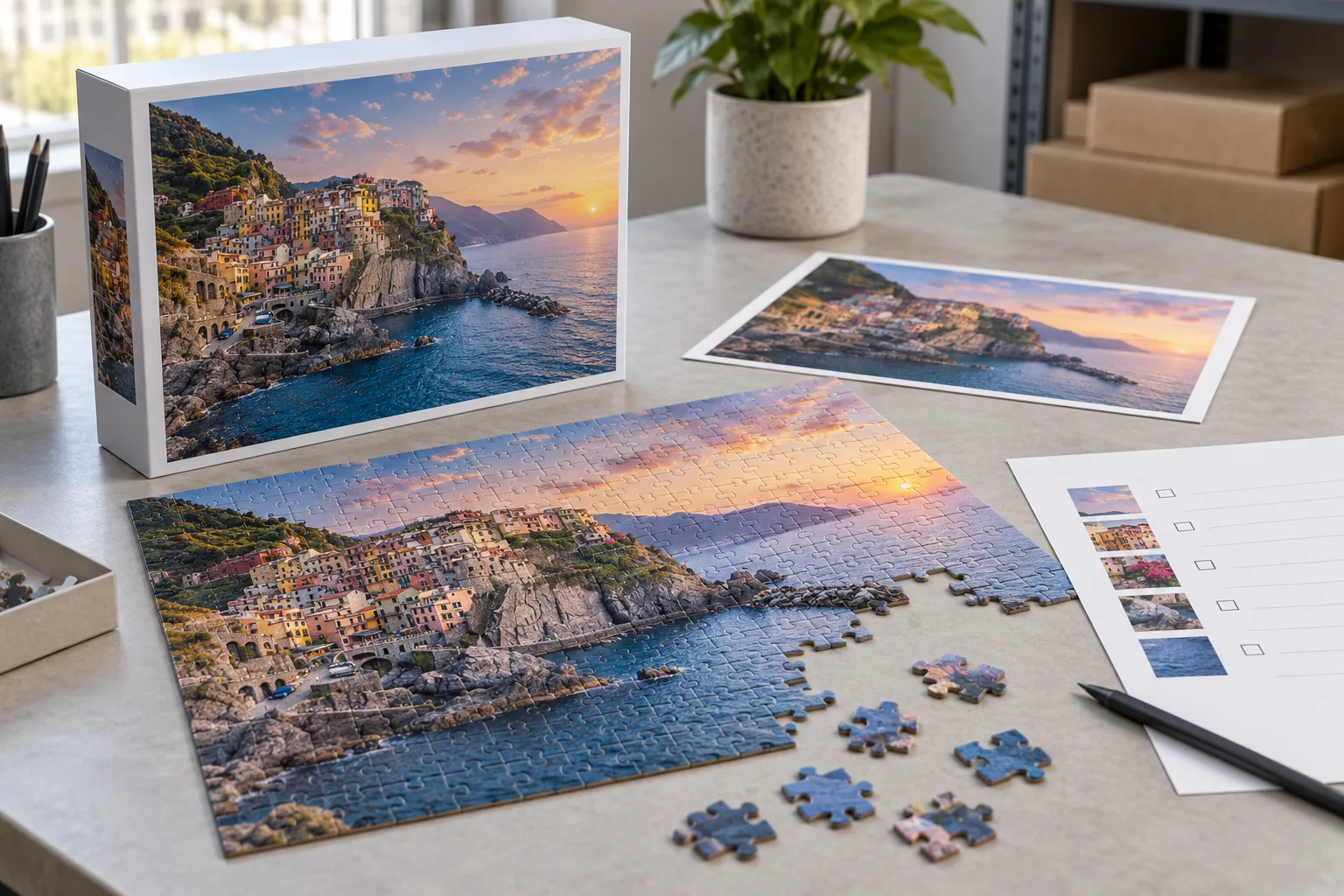
Approve a defined puzzle unit, not just an attractive photograph of one. Check the final artwork version, finished size, piece count and cut pattern; assemble the physical pieces; open and close the filled box; count every agreed insert; and record what the supplier’s sample does and does not represent. A screen proof can catch text and layout errors, but it cannot demonstrate piece fit, board feel or how a full bag of pieces fits inside the retail box.
Before approval, ask the supplier to identify the sample type, materials, print method, die or cutting method, packaging construction and any differences from planned mass production. Then send one written approval tied to a dated file version and sample reference. If a later change affects artwork, board, cut, coating, box or contents, ask whether the affected part needs a new proof or sample.
South Print’s custom jigsaw puzzle printing page shows the product scope. The retail 1,000-piece example is one finished-product direction, not a universal sample specification. Sample type, charge, timing and availability should be confirmed for the actual project.
First, Ask What the Supplier Is Sending
“Sample” can describe several different things. They answer different approval questions.
| Item | Useful for checking | Does not by itself prove |
|---|---|---|
| Digital artwork proof or PDF | Image placement, text, version, dieline alignment and visible copy | Actual printed color, board feel, cut fit or packed box dimensions |
| Printed color proof | Image tone and detail under the stated proofing conditions | Final die-cut feel, exact production color under every condition or complete pack-out |
| Structural or unprinted dummy | Size, board thickness direction, box fit and opening sequence | Final artwork color or finish |
| Assembled puzzle sample | Piece shape, assembly experience, finished size, apparent cut quality and printed surface | Every unit in a production run or an automatic safety approval |
| Packed pre-production sample | Combined puzzle, inner pack, inserts, box, labels and seal as specified | That a later changed design or material will behave identically |
These are possible proofing tools, not a promise that every supplier offers each type or that every project needs all five. Ask which ones are included in the quote and whether the physical sample uses the planned production board, print process, die and packaging. A mock-up produced by a different method can still be useful, but its limits should be stated before the buyer signs off.
Color needs special care. An image on a monitor is not a reliable physical color standard on its own. Soft-proof accuracy depends on the monitor, profiles and viewing conditions; a printed proof also depends on its own printer, paper and profile. If a brand color or artwork detail is critical, agree on a suitable color reference and the intended production process with the supplier. Do not assume an ordinary office print or phone photo is a color match to a future press run.
What to Check on the Physical Puzzle
1. Image, Orientation and Cut Placement
Compare the sample with the approved artwork. Check that the image is upright, the intended crop is present, and important faces, lettering, logos or QR codes are not lost at the outer trim. Look for visible print defects or unexpected changes in shadows and fine detail. If the box has a reference image, make sure it matches the puzzle version inside.
The puzzle artwork guide covers source files, image ratio and dieline coordination. At sample stage, the question is simpler: does the object in hand match the particular file and revision that the buyer approved?
2. Finished Size and Piece Count
Measure the assembled puzzle against the agreed finished dimensions. Count or otherwise verify the intended piece count using the agreed production method; don’t rely only on a box-front claim. If a puzzle uses an existing die option, confirm that the specific die, orientation and piece count fit the chosen finished size. Two puzzles described as “500 pieces” can still have different assembled sizes, piece shapes or cutting layouts.
3. Assembly Experience
Assemble at least one complete sample when feasible. Check that pieces separate cleanly, sit together as expected, and are not obviously torn, bent or delaminated. Note any unusually tight or loose fit, image peeling at edges, miscut sections or repeated-looking cuts that make assembly confusing. One sample cannot establish a statistical defect rate, but it can reveal issues that a flat printed sheet will not.
Ask the supplier what level of handling variation is expected for the chosen board and cutting method. Do not turn a subjective impression such as “firm fit” into an unstated acceptance standard. If the buyer needs a measurable tolerance or specific test, agree on it before production.
4. Surface and Board
Check the apparent board thickness, rigidity and surface finish against the quoted specification and any signed reference. Look at both sides of several pieces, including corners and the outer edge. A sample made on substitute stock is not enough to approve board feel or cut performance for the final stock. Confirm whether a coating, lamination or special finish is included, and whether it appears on the puzzle, box, or both.
Check the Complete Pack-Out
A puzzle can assemble well and still fail as a retail or promotional unit if its packaging does not work. Put the full intended number of pieces into the specified inner bag or containment system, add the agreed poster or insert, and close the actual box. Check that the lid, tuck flaps, sleeve or seal works with the filled contents. Review box artwork, barcode area, warnings and required market information as supplied by the buyer. Inspect the export-carton plan separately from the consumer box.
The packaging guide for retail, promotions and gifts explains why these uses can call for different boxes. A simple promotional carton may be a reasonable choice, but it still needs a physical fit check with its contents. A presentation-focused gift box needs the same check for opening sequence and inserts.
If the puzzle is intended for children or a marketplace with specific documentation requirements, treat sampling and compliance as separate workstreams. A visual approval does not replace product classification, required tests, labels or documents. Use the US and EU puzzle safety buyer checklist to frame those questions with the importer, test lab or marketplace contact.
Approve Against a Written Reference
Send one concise approval record that both parties can retrieve later. It should state:
- Order or project name and the number of designs being approved.
- Artwork filename, revision/date and any separately approved box or insert files.
- Finished puzzle size, piece count, board, printing, surface finish and confirmed cut/die.
- Contents per unit: inner pack, poster, instructions, promotional insert, box and seal, if applicable.
- Sample identifier or dated photographs, plus which physical sample the buyer retained.
- Approved exceptions: any component made with substitute material or a different process that still needs confirmation.
- Specific changes required before production, with a new proof or sample if the change affects a critical feature.
For example, “approved for layout only” is different from “approved as the production reference for puzzle, box and packed contents.” Use those distinctions explicitly. If several artworks share one size and box structure, a common structural sample may answer a packaging question, but each artwork still needs its own final content and version approval. Whether a shared physical sample is sufficient for other attributes must be agreed with the supplier; it is not a blanket rule for safety testing or marketplace documentation.
When Should You Ask for a Revised Sample?
Ask for a revised proof when the changes affect printed text, artwork placement or dieline. Consider a revised physical sample when the change affects piece geometry, board or coating, box dimensions, inner packing, contents or the opening experience. A color-sensitive design may also need another color proof under agreed conditions. Confirm the impact on sample cost and schedule before making the change.
Avoid approving a list of unresolved changes with no clear final reference. If the supplier says a correction will be made in mass production without another sample, ask how that correction will be checked and recorded. The appropriate route depends on the importance of the change and the production method.
What to Send with a Sample Request
Provide the finished puzzle size and piece count, quantity per artwork, target market and user, final or near-final image files, desired board and finish, packaging structure, contents per box, sales channel, and the approval decision you need the sample to support. State whether you need to evaluate color, structure, assembly, retail appearance or all four. Include a delivery address for the sample and any event or launch date, while allowing the supplier to confirm a realistic schedule.
For a broader RFQ checklist, see what information to send for a custom paper-product quote. Sample and production charges, freight and revisions should be itemized rather than inferred from an online puzzle reference price.
To discuss a puzzle sample and quote, email sales@southprintcn.com or contact South Print on WhatsApp. Include the intended use, finished size, piece count, quantity by design and packaging requirements.
FAQ
Is a PDF proof enough to approve a custom jigsaw puzzle?
It can be enough to approve stated artwork and layout details. It cannot by itself verify physical piece fit, board feel or whether the filled packaging works. Ask which aspects the proof is intended to approve.
Will a printed sample match mass-production color exactly?
Do not assume an exact match. Ask whether the sample and production use the same materials and print process, and agree on an appropriate color reference and acceptance method for color-critical work.
Can one sample cover several puzzle designs?
One structural sample may help assess a shared size, cut and box, if those are genuinely the same. Each design still needs its own final artwork and content approval. Safety testing and marketplace documentation have separate rules; a shared sample does not automatically cover them.
What if I change the box after approving the puzzle sample?
Request a revised box proof and consider a new packed sample. Box depth, closure and insert fit can change even when the puzzle itself is unchanged. Confirm any added cost or schedule impact before approving the revision.
Does sample approval replace safety testing?
No. A visual or functional sample helps buyers approve the agreed construction. Product classification, applicable tests, labels and documents must be handled under the relevant market and sales-channel requirements.