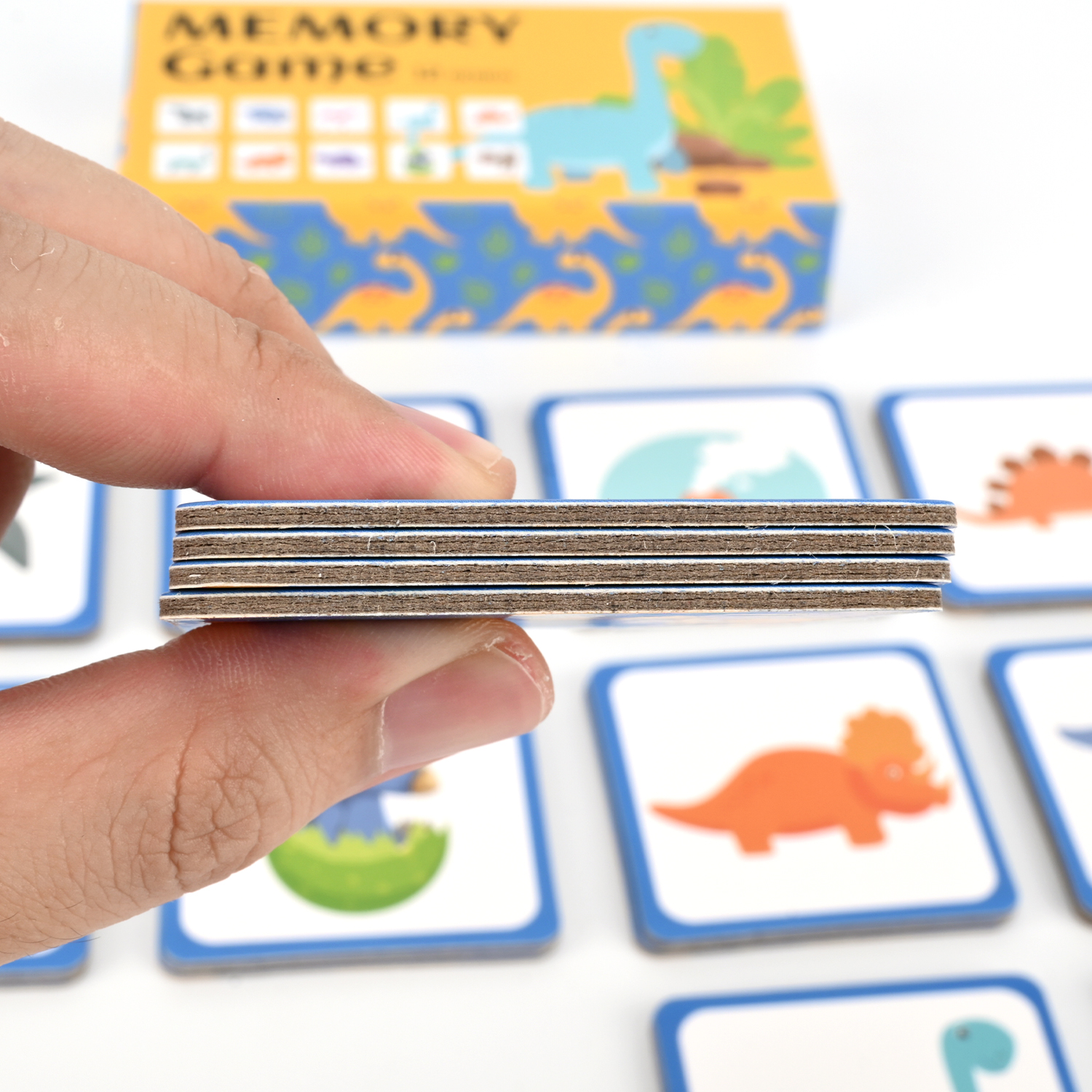
Product photo: a printed Memory Card game stack viewed from the edge. This is one construction example, not a side-by-side comparison of card stocks.
Short Answer
Start with how the cards will be used, not with a paper weight picked from another product. A matching game needs cards that feel consistent and do not reveal faces through the back. A flash-card deck used repeatedly in a classroom needs legible print and a finish that suits frequent handling. A deck that players shuffle needs a different balance of flexibility, opacity and surface feel from a thick display or gift card. Cards intended for handwriting need a tested writable surface rather than an assumed “matte” finish.
Ask the printer for physical samples and specify the required paper construction, measured thickness, opacity, stiffness and finish. GSM tells you mass per square metre; it does not, by itself, tell you exact thickness or handling performance. Evaluate the finished printed card on both sides, cut to the intended size and corner shape, before fixing the box dimensions.
South Print’s custom Memory Card and card-deck page describes custom paper thickness and finish as project variables. The matching-game example shows one card-set format, not a standard material for every deck. Material names below are options to discuss and sample, not a statement that every construction is stocked or suitable for every production method.
Match the Material to the Handling
| Intended use | First performance question | What to test on a finished sample |
|---|---|---|
| Face-down Memory Card matching game | Can players identify a face through the card or an inconsistent back? | Opacity under the intended light, consistent backs, edge and corner appearance, repeated flipping |
| Flash Cards for study or classroom use | Can the cards be read, sorted and handled repeatedly? | Print legibility, stiffness, wipe or scuff behavior, corner durability and stack weight |
| Playing or game deck shuffled frequently | Can users shuffle and deal the deck comfortably without seeing faces? | Flex, recovery, friction, opacity, surface wear and how the deck behaves as a full stack |
| Artist, museum or collector deck | Does the material support the intended image and tactile experience? | Color reproduction, surface texture, edge quality and feel in the chosen package |
| Write-on learning or prompt cards | Does the chosen pen or pencil work after printing and finishing? | Ink drying, smearing, pencil grip and erasing on the actual printable area |
These are starting questions, not a rule that each product must use a different stock. A deck can serve more than one purpose. For example, a Memory Card game for a classroom may need both face-down opacity and resistance to frequent handling. Tell the printer which requirement takes priority when tradeoffs arise.
Why GSM Alone Is Not a Material Specification
GSM is a paper’s weight per square metre. Caliper is measured thickness, commonly expressed in millimetres or points. Two card stocks with the same gsm can have different thickness and stiffness because their fibers, bulk, coating and layered construction differ. Conversely, a higher-gsm sheet is not guaranteed to feel better for shuffling. This is why a deck specification should record both material weight and measured thickness instead of relying on gsm alone.
For a card-deck quote, ask for a proposed stock name or construction and its nominal gsm and thickness. Then handle a cut and finished sample. Note whether the card bends and recovers, feels brittle at a corner, or makes an inconveniently thick stack. This matters to packaging: the card-deck packaging guide explains why card count, actual stack thickness and booklet contents determine the filled box size.
If a supplier says only “300 gsm card,” ask whether it is coated or uncoated, single-sheet or layered, and which surface treatment will be applied. Do not copy another supplier’s caliper figure into the South Print specification; those figures are not automatically transferable across paper brands and constructions.
Compare Common Construction Directions
Coated Cardstock for General Printed Decks
A coated card stock is a useful discussion starting point when sharp color printing and a reasonably compact stack are important. It can suit many learning, promotional, game and gift decks, subject to the actual weight, finish and handling tests. Coating is a print-surface description, not a durability guarantee: a varnish or lamination, if used, changes the final feel and should be sampled as part of the finished card.
Choose by performance rather than by an automatic “premium” label. A heavier coated sheet may feel substantial but make a large deck bulky. A lighter stock may be easier to shuffle but less suitable for a card meant to feel like a sturdy learning tile. Ask the printer to show two or three feasible alternatives at the same final card size, with the intended print on both sides.
Opaque-Core Stock for Hidden Card Faces
Black-core and other opaque-core constructions are used where light passing through a card could reveal the face. This matters for face-down matching games and some shuffled games. The core color is not the only factor: artwork, back consistency, finish and room lighting can also affect whether a player can identify a card. Test the actual printed design under the lighting in which the game will be used.
Do not assume an opaque core is automatically thicker or more durable than every white-core card. Its advantages and limitations depend on the complete construction. It may also behave differently in a chosen print or sampling process, so confirm availability and the production method with the printer. An unprinted swatch does not prove how the final double-sided card will perform.
Mounted or Multi-Ply Cards for a Thicker Hand Feel
Some card products use two or more sheets bonded into a thicker card. This can be worth discussing for a large-format learning card or a sturdy, low-card-count set that is picked up individually rather than shuffled. The construction must be checked for edge appearance, consistent thickness, adhesion and cut quality. A mounted card can make the finished stack much deeper and the package larger.
More thickness is not always better. A 60-card deck made from a very thick construction can become awkward to hold or fit into a compact carton. For a frequently shuffled game, ask for a complete-deck handling sample before specifying a multi-ply card. Any mounted construction, available thickness and assembly method need a project-specific quote.
Uncoated or Writable Surfaces
If a teacher, student or customer will write on a card, name the intended tool: pencil, ballpoint pen, felt-tip or another marker. A printable uncoated side may support writing better than some sealed or laminated surfaces, but writeability varies by stock, ink and finish. Test writing, drying, rubbing and, if relevant, erasing on the finished printed sample. A marketing word such as “matte” does not prove that a card is writable.
Consider whether only one side needs to be written on. A two-sided product may need a different surface or design on the image side. If the card must be wipe-clean rather than permanently written on, that is a different requirement and should be specified separately. Avoid promising that a given coating is washable or safe for a particular age group without an approved sample and applicable assessment.
Surface Finish Changes the Use Experience
Gloss, matte, varnish, lamination and textured finishes affect appearance and handling, but the names alone are not enough to select them. A glossy surface can make color appear vivid yet show glare in some settings. A matte surface can reduce glare but may reveal rub marks or fingerprints differently. A textured surface may change shuffling friction and small-text clarity. The result depends on the exact stock, ink, finish and print process.
Request comparable samples under the lighting and handling that matter to the buyer. For a classroom deck, test reading at arm’s length and repeated stacking. For a shuffled deck, handle the whole deck, not just one card. For a printed image deck, compare the actual illustration or photograph and check the cut edge and corners after normal use. Specify whether the finish is on one or both sides; one-sided and two-sided finishing are not interchangeable.
The Memory Card vs Flash Card article explains how product purpose changes the content and quotation details. The separate Memory Card artwork guide covers pair lists, common backs and file setup. Material selection should be confirmed alongside those decisions, not after the box dieline is finalized.
A Practical Sample Test Before You Approve the Stock
Ask for a small set of finished cards, ideally printed with the project’s real dark areas, fine text and back design. Record the exact stock and finish used for each sample. Then:
- Compare opacity by placing a face-down printed card under the intended lighting and checking whether the face can be inferred.
- Bend and release the card gently; compare recovery and corner condition across options without assuming a single hand test predicts full production durability.
- Handle a realistic full stack to assess shuffling, sorting, weight and storage.
- Read small text and inspect image color on both sides; check for glare and surface marks.
- Test the intended pen or pencil if the card will be written on.
- Measure the packed stack with any title, instruction or divider cards before approving the box.
A digitally printed sample or a sample on substitute stock may be useful for artwork and size approval but may not represent the final surface, opacity or shuffle feel. Ask the supplier to state what the sample matches and what it does not. Do not treat a single sample as a statistical guarantee for the mass-production run.
For children’s products, material selection and legal compliance are separate decisions. Card stock, corner radius or lamination alone does not establish an age grade or certification. The buyer or importer should identify the applicable market rules and approve required tests, labels and warnings for the complete product.
What to Send for a Material Quote
State the card’s use, finished size, total cards per set, pair count for matching games, quantity by design, print on one or both sides, whether hidden faces or handwriting matter, expected handling frequency, desired feel, finish, corner shape and packaging. Supply sample artwork with both light and dark content if available. Ask the printer to propose a few feasible stocks with nominal gsm and caliper, then quote each as a complete set with the same packaging and shipment scope.
Do not transfer South Print’s published standard Flash Card reference price to a Memory Card game, opaque-core card, mounted card or special finish. Those constructions require their own material, process, card-count and packaging quote. For a complete inquiry checklist, use the custom paper-product RFQ guide.
To discuss a card material sample and quotation, email sales@southprintcn.com or contact South Print on WhatsApp.
FAQ
Is 350 gsm always better than 300 gsm for custom cards?
No. GSM measures mass per area, not the complete card’s thickness, opacity, flexibility or surface behavior. Compare actual stock and finished samples against the intended use and box capacity.
Do Memory Card matching games need black-core paper?
Not automatically. They need backs and card construction that do not reveal card identities during normal play. An opaque-core stock is one possible solution; test the final printed card and compare it with other feasible materials.
Can a matte-laminated flash card be written on?
Do not assume so. Writeability depends on the exact laminate, ink and writing tool. If buyers need to write on the card, test the finished surface with the intended pen or pencil before approval.
Are thicker cards always more durable?
No. Thickness is only one factor. Bonding, fibers, surface finish, edge quality and how the deck is handled also matter. A very thick card may be harder to shuffle and can require a larger box.
When should I choose the box size?
After the card count and production-intent stock and finish are known. Use the full stack, including instruction and title cards and any inner wrap, to confirm the packed internal dimensions with a physical sample.