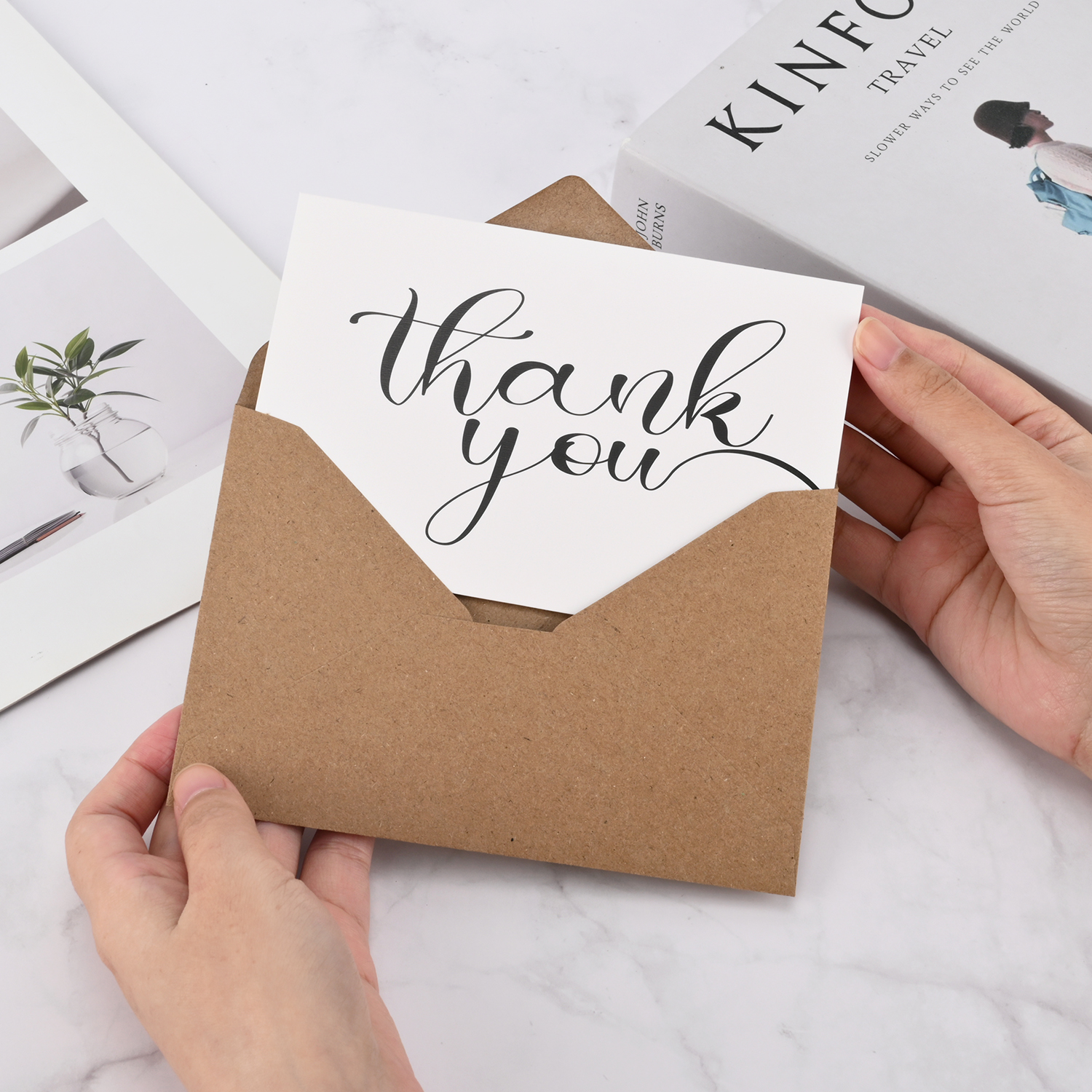
Short Answer
Choose the envelope after confirming the finished folded card size, paper and contents, not by copying an envelope name from another supplier’s listing. A 4 x 6 inch folded card can be discussed with an A6-style announcement envelope and a 5 x 7 inch card with an A7-style envelope, but those are starting points for a physical fit test, not automatic approvals. Flap shape, side seams, card thickness, inserts and how the product is packed can change the usable space.
Decide whether customers will mail one card, buy a boxed retail set, or use the cards as unmailed gifts or inserts. Then specify envelope size, paper, color, flap, closure, printing and quantity per sellable unit. South Print’s standard 4 x 6 and 5 x 7 reference prices include one unprinted blank envelope per folded card. An envelope with a printed logo, address, full-color design or special paper is a different specification and needs its own quote.
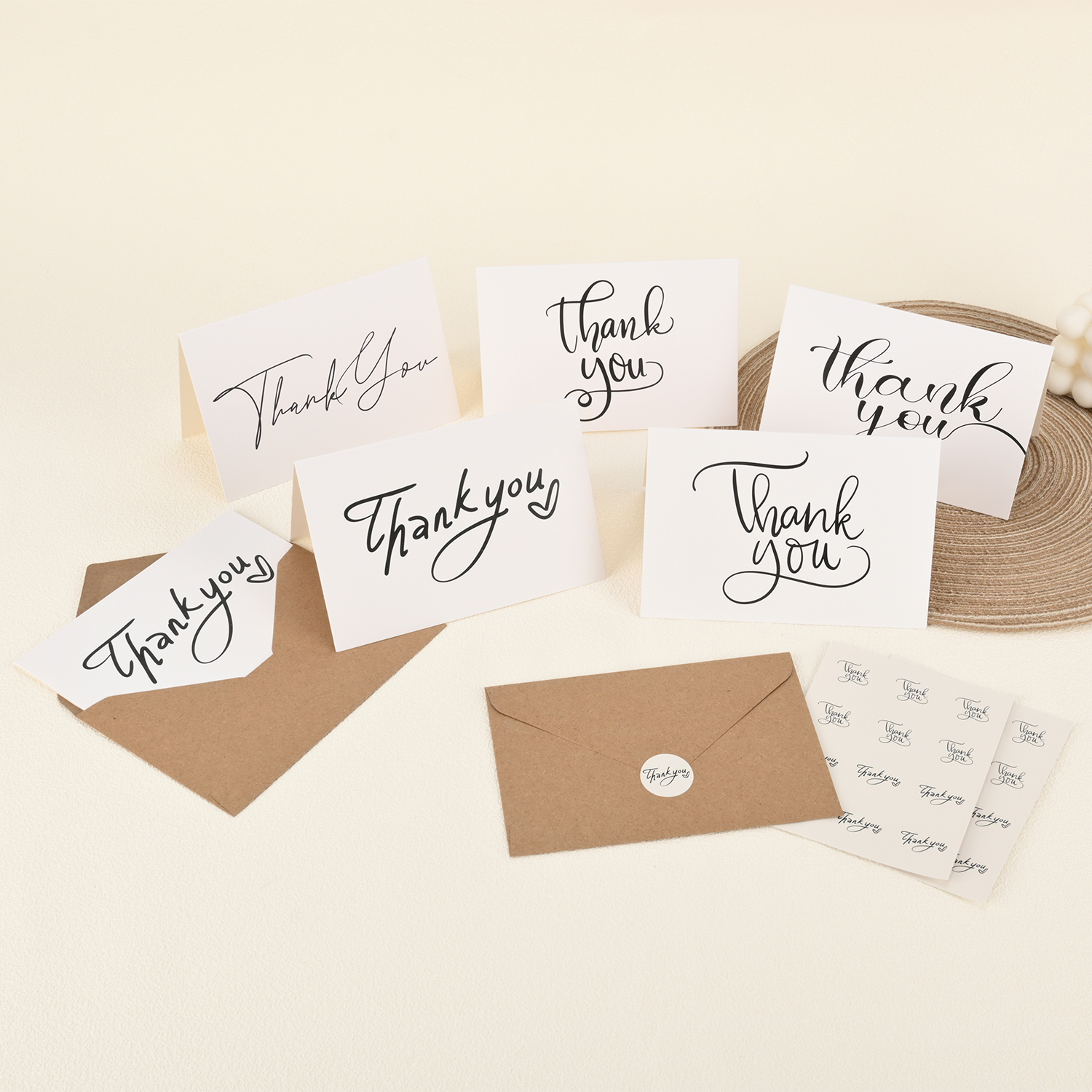
South Print product photo: a card-and-envelope assortment. Confirm finished dimensions, envelope count and fit for the actual order.
Start With the Card That Goes Inside
The folded size is the outside size of the closed card. The flat, open artwork size is larger and should not be mistaken for the insert that will go into the envelope. For a 4 x 6 inch folded card, supply 4 x 6 inches folded in the RFQ. For a 5 x 7 inch folded card, supply 5 x 7 inches folded. If the card has a pop-up, layered decoration, foil, a thick paper stock, an insert or a belly band, tell the printer because a nominal size alone does not describe the filled thickness.
| Folded card | Common US-style envelope to discuss | Nominal envelope outside size | Check before approval |
|---|---|---|---|
| 4 x 6 in | A6-style announcement envelope | 4.75 x 6.5 in | Finished card and any insert slide in, flap closes, presentation looks balanced |
| 5 x 7 in | A7-style announcement envelope | 5.25 x 7.25 in | Side clearance, card thickness, seams and closure on the finished sample |
These are published nominal sizes for common US announcement envelopes, not a statement that South Print supplies every paper, flap and closure in both sizes. Neenah’s envelope guide shows A6 and A7 announcement-envelope dimensions. A named envelope may still differ by manufacturer or structure, so state the actual dimensions in inches or millimetres in the purchase specification.
There is also a naming trap: a US A6 envelope (4.75 x 6.5 in) is not the same thing as an ISO A6 sheet or card (105 x 148 mm). When an international buyer says “A6,” ask whether they mean the envelope size or the A-series paper size. A size name without measurements is not enough to release an envelope dieline.
Test Fit With the Finished Card, Not a Screen Mockup
Place the actual finished folded card into a production-intent envelope. Check that it enters without scraping the corners, sits evenly, can be removed without tearing the flap, and remains inside when the envelope is handled normally. If the card is printed on a textured or thick paper, compare the fit after folding and finishing, not before. A decorative envelope liner or a second insert also takes space.
For a mailed card, close and reopen a sample using the intended sealing method. For a boxed set, stack the exact card-and-envelope count and place it in a sample box. The envelope flap and seams contribute to the stack height, so the box depth should be finalized from all components together. The boxed greeting card set guide covers set counts, design allocation and retail assembly in more detail.
Choose the Envelope Finish and Closure by Use
An unprinted blank envelope is often enough when the card itself carries the artwork and the customer writes the address. A colored, textured or kraft envelope may help a stationery line’s presentation, but paper shade and surface should be checked against the card, expected handwriting or address label, and printing method. Do not assume every specialty envelope will match the card stock or accept the same ink and finish.
The flap shape is part of the visual design, yet it also changes how the envelope opens and closes. A traditional gummed flap, a peel-and-seal strip and a separate sticker are different pack-out and cost choices. Confirm what is supplied unsealed for the end customer and what, if anything, is sealed during factory assembly. A boxed set intended for the customer to use later should not arrive with its individual envelopes sealed shut.
| Use | Practical starting point | Specification to confirm |
|---|---|---|
| Retail card sold with one envelope | Unprinted blank envelope | Actual size, paper color, flap and one-to-one count |
| Branded mail campaign | Printed envelope | Artwork, address method, barcode or postal clear area, print proof and destination rules |
| Premium boxed assortment | Coordinated paper or color | Envelope count per set, design matching, stack height and box fit |
| Event giveaway not mailed individually | Simple envelope or no envelope | Whether the envelope has a real use or only adds cost and bulk |
For paper and finish choices on the card itself, see the greeting card paper guide. The card paper and envelope paper can be intentionally different, but they should be approved together as one sellable unit.
Blank Versus Printed Envelopes: Keep the Price Boundary Clear
South Print’s published planning prices for a folded 4 x 6 or 5 x 7 inch card include one standard unprinted blank envelope per card at the stated quantities. They are not fixed prices for custom printed envelopes, colored specialty stock, peel-and-seal closures, inserts, retail boxes or postal mailing. The 4 x 6 vs 5 x 7 guide gives the current card-and-blank-envelope reference figures.
An envelope printed on one face, two faces or the flap may have different file and production requirements from a stock blank envelope. If an address or QR code changes for every recipient, tell the supplier that the data is variable rather than describing the job as one repeated envelope design. Ask who provides and checks the recipient list, whether the printer is only supplying blank or preprinted envelopes, and whether mailing or fulfillment is included. Do not assume printing the envelope means the supplier will address, stamp or mail it.
For a clear quote, request at least two versions if you are undecided: standard unprinted envelope and the specific printed or specialty version. Compare the complete card-and-envelope unit at the same quantity and with the same packing and delivery scope. Do not multiply a card-only reference price by a boxed-set count and treat it as a final retail-set cost.
If the Buyer Will Mail the Card
The final mailed item is the filled, addressed and sealed envelope, not just the empty envelope. A paper choice that looks good in a retail box may be less suitable for legible machine reading, handwriting, or a particular postal service. If the cards are mailed in the United States, USPS letter-size guidance specifies size and thickness limits for letter pricing and warns that square, rigid or unusual pieces can trigger different handling and postage. USPS addressing guidance also calls for clear addresses and reasonable contrast. Requirements and prices in other destinations must be checked with the relevant carrier or mail service.
This is a mailing-design check, not a promise that a particular South Print envelope will qualify for one postage category. The contents, final weight, thickness, flexibility, address layout and current destination rules determine that result. Ask the buyer’s mailing partner to check the filled sample before a large print run. Avoid adding a dark printed design beneath the address without verifying readability.
If the cards are intended only for gifting or retail sale, do not pay for a postal feature that no customer needs. Conversely, a card sold with a decorative envelope still needs a usable address area if the buyer expects customers to mail it.
How Many Envelopes Go in a Retail Set?
State the number of sellable sets, cards per set and envelopes per set separately. For example, 500 boxes containing 12 cards and 12 envelopes require 6,000 cards and 6,000 envelopes before any approved spare or quality-control allowance. If there are four card designs, also state how many of each design go into one box. An envelope can be shared across card designs when size and presentation are the same; that does not make the printed card quantities per design interchangeable.
For 12-, 24-, 50- or 100-card sets, decide whether the envelopes are nested behind individual cards, placed in one stack, divided from the cards or packed in a separate inner bundle. This affects assembly time and box depth. A sample should be packed exactly as customers will receive it, including any label, belly band, divider or wrap. The boxed-set case shows a related product format; the actual specification must still be confirmed for each order.
Envelope RFQ Checklist
Send the following with your custom paper-product RFQ:
- Finished folded card size, card paper and any insert, pop-up or special finish.
- Required envelope outside dimensions or a sample envelope, not just “A6” or “A7.”
- Envelope paper, color, opacity and surface; mark undecided choices for supplier recommendation.
- Flap shape and closure method, including whether the envelopes must reach the buyer unsealed.
- Unprinted, printed or variable-address envelope; printing sides, coverage and approved artwork.
- Card quantity by design, sellable set quantity, cards and envelopes per set, and spare count if needed.
- Individual mail use or boxed retail use; packing sequence, box structure and destination.
- Whether addressing, sealing, mailing or fulfillment is included in the requested service. Do not assume it is.
Review South Print’s custom greeting card printing options, then send a finished-card sample or dimensions, target quantity and intended use for a project quote. Email sales@southprintcn.com or contact us on WhatsApp.
FAQ
Does a 4 x 6 inch greeting card always need an A6 envelope?
No. A6-style announcement envelopes are a common starting point in the US market, but usable fit depends on the actual envelope, card thickness, inserts, seams and flap. Confirm the envelope’s measured dimensions and test a finished card.
Is an A6 envelope the same as an A6 paper-size card?
No. The names refer to different sizing systems. State the envelope’s outside dimensions and the card’s finished folded dimensions in inches or millimetres to avoid ordering the wrong component.
Are printed envelopes included in South Print’s greeting card reference prices?
No. The published reference is for one standard folded 4 x 6 or 5 x 7 inch card plus one unprinted blank envelope at the stated quantity. Printed or specialty envelopes and boxed-set assembly need a separate project quote.
Can I put 12 cards and 12 envelopes in one retail box?
Yes, that is a common planning format, but specify the number of designs and copies of each design, envelope count, packing order and box structure. Approve a filled sample before finalizing the box depth and quote.
Will a decorative envelope qualify for standard letter postage?
Not necessarily. The filled envelope’s size, thickness, weight, flexibility, shape and address layout matter, and postal rules vary by destination. Ask the mailing service to assess a finished sample and current requirements.