Short Answer
A custom boxed greeting card set should be planned as one complete retail unit, not as loose cards placed into a box at the end. Before requesting a quote, define the number of sellable sets, cards per set, envelope count, number of designs, copies of each design in every set, box structure, collation order, labels, retail sealing, and export packing.
Common planning counts include 12, 24, 50, or 100 cards per set, but these are not fixed rules or minimum order quantities. A set may contain one repeated design, several designs in equal quantities, or a purpose-based assortment such as birthday, thank-you, sympathy, congratulations, and blank cards. Each format creates different printing, sorting, box-depth, assembly, and inventory requirements.
South Print’s website reference prices for folded 4 x 6 and 5 x 7 greeting cards cover one standard folded card plus one unprinted blank envelope at the displayed card quantities. Those figures can support early card-size planning. They should not be multiplied by the number of cards in a set and treated as a final boxed-set price. The retail box, printed envelopes, special finishes, collation, assembly, sealing, export packing, and freight must be checked separately.
Define the Sellable Unit First
The most useful starting question is: what exactly will one customer receive?
Write the answer as a complete bill of contents. For example:
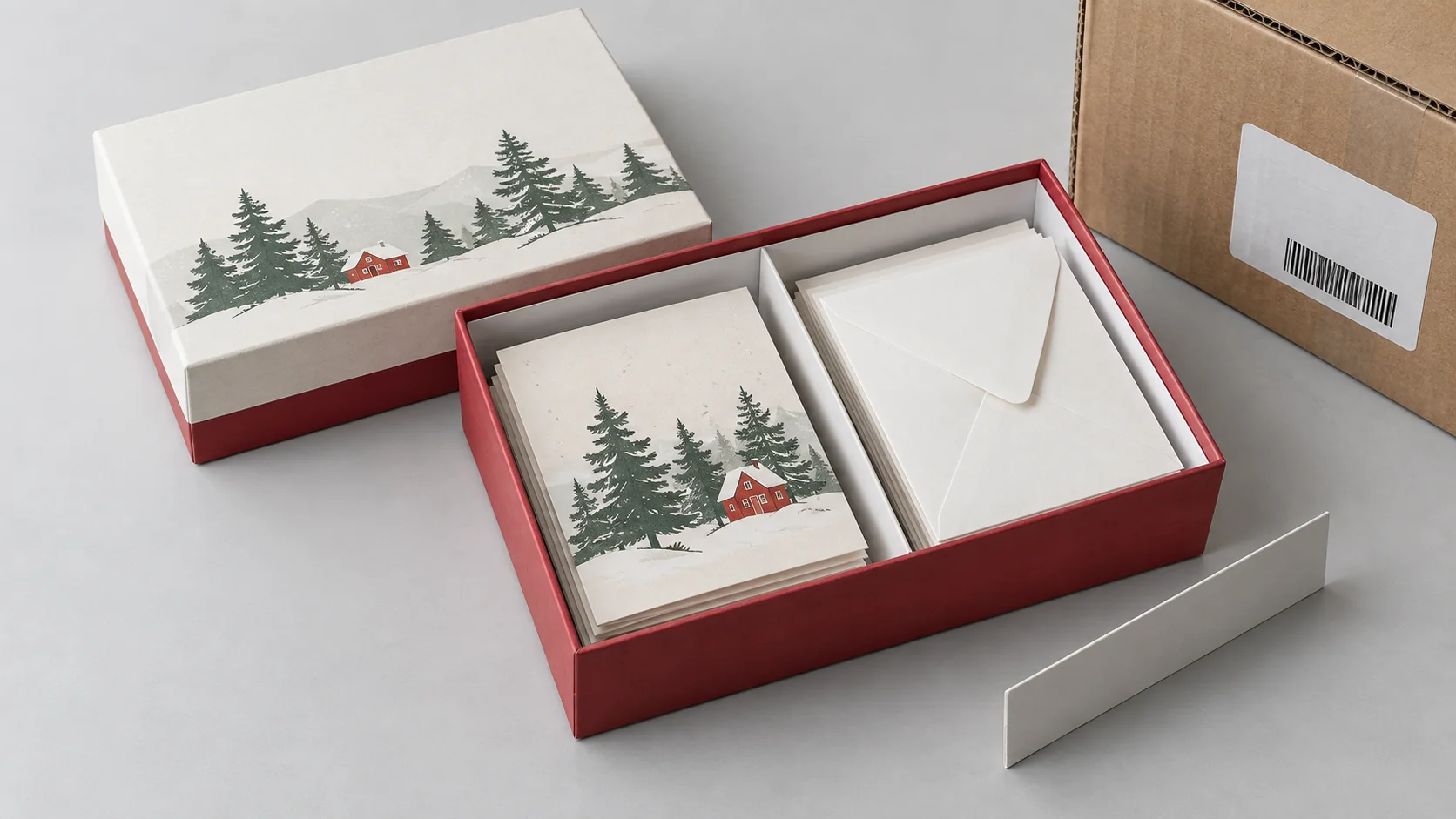
One retail set contains 12 folded 5 x 7 inch cards, 12 unprinted blank envelopes, 4 card designs with 3 copies of each design, one printed divider, and one custom lid-and-base paperboard box with a barcode label.
That sentence establishes the sellable unit. It gives the printer enough structure to discuss card quantities, design allocation, envelope purchasing, box depth, sorting, assembly, and labels.
A vague request such as “quote 1,000 greeting cards in boxes” leaves several different interpretations:
- 1,000 cards packed into bulk cartons.
- 1,000 cards divided into 100 retail sets of 10 cards.
- 1,000 retail sets, each containing 10 cards, meaning 10,000 cards in total.
- A one-design set with repeated cards.
- A mixed set that requires several designs to be sorted in a fixed ratio.
These are different production jobs. The RFQ should use “sets” for sellable retail units and “cards” for the physical cards inside those units.
Choose the Set Configuration
One Design Repeated
A single-design set contains several copies of the same card. Examples include a box of thank-you cards, one seasonal greeting, or one museum artwork.
This format can simplify file control and collation because every card has the same artwork. Buyers should still define cards per set, envelopes per set, total retail sets, and whether the cards need to face the same direction or follow a specific packing sequence.
Example: 500 retail sets x 12 identical cards = 6,000 cards and 6,000 envelopes.
Multi-Design Assortment
A mixed set contains several designs in a known ratio. For example, a 12-card set may contain 4 designs with 3 copies of each design. A 24-card set may contain 6 designs with 4 copies of each.
The buyer should provide a design allocation table. Equal quantities are easy to describe, but they should never be assumed. A set with 12 designs at one copy each is different from a set with 4 designs at three copies each, even though both contain 12 cards.
Example: 1,000 retail sets x 12 cards, with 4 designs x 3 copies per set, requires 12,000 cards total and 3,000 cards of each design.
Occasion or Theme Assortment
An occasion assortment is planned around customer use rather than equal design counts. A 24-card set might contain more birthday cards than sympathy cards, or a museum set may divide cards by artist, collection, or exhibition theme.
This format needs a clear packing map because the quantity per design may be unequal. The box copy should match the actual contents, and the final barcode or SKU should identify the approved assortment. If the contents change for a seasonal or channel-specific version, confirm whether the retail identifier, box artwork, or fulfillment labels also need to change.
Keep Four Quantity Fields Separate
For a reliable quote, state these four numbers independently:
| Quantity field | What it means | Example |
|---|---|---|
| Total sets | Number of finished retail units | 1,000 boxed sets |
| Cards per set | Physical cards inside each box | 12 cards |
| Design count | Number of unique card artworks | 4 designs |
| Quantity per design | Total cards printed for each artwork | 3,000 cards per design |
In the example above, the order contains 12,000 cards, 12,000 envelopes, and 1,000 retail boxes. The four designs are each printed 3,000 times.
This separation also matters when requesting price options. A quote for 500 sets and a quote for 2,000 sets should preserve the same cards-per-set and design allocation unless the buyer intentionally wants a different configuration. Otherwise, the two unit prices do not describe the same product.
For a deeper explanation of total quantity and quantity per design, see Why Custom Printing Unit Prices Drop at 200, 500, and 2,000 Units.
Use 12, 24, 50, and 100 as Planning Counts
South Print’s boxed greeting card case lists 12, 24, 50, and 100 cards as common set counts. They help buyers compare a compact stationery set with a larger household, corporate, or seasonal assortment. They do not establish one standard pack or a guaranteed MOQ.
The best count depends on:
- Retail price position and expected use.
- Number of designs and desired copies per design.
- Folded card size and paper thickness.
- Envelope thickness and flap construction.
- Whether the set includes dividers, inserts, stickers, or instructions.
- Box structure and shelf footprint.
- Parcel weight, carton volume, and fulfillment limits.
- Expected sell-through and reorder plan.
A 12-card set can support a focused artist collection or first product test. A 24-card set gives more room for several designs or occasions. A 50- or 100-card set may suit household, office, subscription, or bulk-gifting use, but the larger stack can require a deeper or stronger box and more assembly work. The final choice should follow the actual product and sales channel.
Treat the Card and Envelope Price as One Input
South Print currently shows these planning references for standard folded cards with one unprinted blank envelope:
| Standard reference format | 200 cards | 500 cards | 2,000 cards |
|---|---|---|---|
| Folded 4 x 6 inch card + one unprinted blank envelope | About USD 0.54/card | About USD 0.16/card | About USD 0.10/card |
| Folded 5 x 7 inch card + one unprinted blank envelope | About USD 0.65/card | About USD 0.25/card | About USD 0.14/card |
These figures are early planning references for the card-and-envelope component. They do not include a custom retail box, printed envelopes, special finishes, dividers, collation, assembly, retail sealing, export packing, freight, duty, or tax unless a quotation states otherwise.
They also use card quantities, not boxed-set quantities. For example, 500 sets with 12 cards each require 6,000 cards. The correct price cannot be selected from the 500-card column simply because there are 500 boxes. The supplier must review total cards, quantity per design, cards per set, and all packaging work.
For the size comparison and its assumptions, read 4x6 vs 5x7 Greeting Card Printing: Cost and Packaging Differences.
Match the Envelope to the Finished Set
Confirm whether each card receives one envelope and whether any spare envelopes are required. The RFQ should state:
- Envelope count per set.
- Envelope finished size and fit with the folded card.
- Paper, color, texture, and flap style.
- Blank or printed envelope.
- Whether envelopes are nested with cards, stacked separately, or divided inside the box.
- Whether the envelope order includes an allowance for sampling, quality control, or replacement, subject to quotation.
Printed envelopes and custom colors can change setup, material purchasing, file requirements, and cost. A thicker or bulkier envelope can also change the final stack height more than expected. Approve the card and envelope combination before the retail box depth is finalized.
Choose a Box Structure Around the Product
Possible directions include a folding carton, tuck-style box, lid-and-base paperboard box, sleeve with inner tray, or a more rigid gift box. Availability, material, structure, and practical order quantity need confirmation for the actual project.
The box should be selected from the product requirements:
- Does the customer need to remove cards frequently?
- Should the set display upright, lie flat, or hang?
- Does the box need a window or a full printed front?
- Will a divider separate cards from envelopes?
- Is the product positioned as everyday stationery or a premium gift?
- Will the box ship directly to consumers or inside another parcel?
A premium box can improve presentation, but it adds material, printing, die cutting, gluing, assembly, and shipping volume. A simpler folding carton may reduce weight and storage volume. The right choice depends on the retail goal and distribution route, not only appearance.
View South Print’s boxed greeting card set with envelopes case for a related project format.
Confirm Box Depth After the Stack Is Known
Box depth should be based on the finished stack, not calculated from nominal paper gsm alone. The stack can include:
- Folded cards, including the fold and any surface finish.
- Envelopes, flaps, seams, and gum areas.
- Dividers, instruction cards, belly bands, or inserts.
- Inner wrapping, tissue, seal, or protective sheet.
- Practical clearance for packing and removal.
Paper bulk and caliper can vary even at the same gsm. Foil, embossing, lamination, textured paper, and heavy ink coverage may also affect handling and stack behavior. A white sample or physical production sample is useful when box fit and retail presentation matter. Final dielines should follow the approved card, envelope, contents, and packing method.
For material decisions, see How to Choose Paper and Finishes for Custom Greeting Card Printing.
Plan Collation, Sorting, and Assembly
Printing the cards and assembling the retail set are separate work stages. A mixed set may require operators or equipment to:
- Separate each design after printing and finishing.
- Count the required copies of every design.
- Arrange designs in the approved order or grouping.
- Add the correct number of envelopes.
- Insert dividers, instructions, or promotional pieces.
- Load the box in the approved orientation.
- Apply a seal, shrink wrap, barcode label, or other retail preparation.
- Pack finished sets into export cartons by SKU.
Collation becomes more complex when there are many designs, unequal design ratios, language versions, seasonal variants, or channel-specific boxes. Provide a visual packing map and one approved reference set. File names, design IDs, box copy, barcode, and carton labels should use the same SKU structure.
Decide Whether Dividers or Inserts Are Needed
A divider or insert can organize the contents, prevent movement, separate cards from envelopes, or create a premium reveal. It also occupies space and adds material and assembly.
Useful options to discuss include:
- A paperboard divider between cards and envelopes.
- A paper band around each design group.
- A printed content card or occasion index.
- An instruction or brand-story insert.
- A fit insert that limits movement inside a larger gift box.
Do not finalize the insert before the finished card stack, envelope stack, and box structure are confirmed. Ask whether it ships assembled, flat, or pre-fitted in the box.
Prepare Retail Artwork, Barcode, and SKU Data
The retail box may need product name, card count, envelope count, design previews, contents, brand details, barcode, SKU, country-of-origin statement, warnings, recycling marks, or other market-specific copy. The required information depends on the destination, retailer, product claims, and sales channel.
The buyer should supply and approve barcode data, legal text, claims, translations, and channel labels. South Print can print approved information but should not be expected to determine every market requirement for the brand.
Treat each fixed assortment as a controlled retail product. GS1 describes a predefined assortment as a fixed combination sold as one physical trade item. If contents, count, or assortment change, review whether the GTIN, SKU, box artwork, listing, or channel records also need revision. Final barcode ownership and allocation remain the brand owner’s responsibility.
Prepare the Fulfillment Handoff
A retail-ready set still needs an export and fulfillment plan. State:
- Finished sets per inner carton and master carton, if applicable.
- SKU and barcode for each set version.
- Carton marks, carton labels, and packing-list format.
- Whether sets need shrink wrap, a tamper seal, or another closure.
- Whether the retail box needs an outer protective pack for parcel delivery.
- Destination country, warehouse type, postal code, and trade term if known.
- Any current retailer, Amazon, third-party logistics, or subscription-box instructions.
Platform requirements can change. For Amazon or another fulfillment network, the buyer should provide the current packaging and label requirements for the destination program. The supplier can then confirm which preparation is practical and quote it. Do not assume that one barcode, carton label, “sold as set” statement, or packing method works for every channel.
Export packing should protect the retail boxes from crushing, rubbing, moisture exposure, and movement during normal handling. Carton size, weight, internal protection, pallet use, and shipping method should be confirmed after the finished retail unit is known. Freight cannot be estimated reliably from card quantity alone.
What to Send in a Boxed Greeting Card Set RFQ
Use this checklist when requesting a planning quote:
- Total finished retail sets.
- Cards per set and envelopes per set.
- Set type: one repeated design, equal mixed assortment, or occasion assortment.
- Design count, copies of each design per set, and total quantity per design.
- Folded card size and open size.
- Printing outside, inside, or both; blank-inside requirement if applicable.
- Paper or quality target and whether writing performance matters.
- Envelope size, paper, color, flap, and printing requirement.
- Surface finish and special processes, including foil, embossing, debossing, spot UV, or lamination.
- Preferred box structure, reference photos, and retail position.
- Divider, insert, belly band, instruction, or brand-story requirements.
- Barcode, SKU, box copy, language versions, and required labels.
- Collation order and a visual packing map for mixed sets.
- Shrink wrap, seal, protective sleeve, or other retail preparation.
- Export carton and fulfillment requirements.
- Destination, trade term if known, and target timing.
- Artwork status and whether a white sample, printed sample, or other proof is needed.
If the box structure is undecided, send a reference product and state what the packaging must achieve. South Print can then review practical directions. For the broader inquiry checklist, see What Information Should You Send for a Custom Paper Product Quote?.
Copyable Configuration Example
Product: Retail boxed folded greeting card set
Total sets: 1,000
Cards per set: 12
Envelopes per set: 12 unprinted blank envelopes
Design count: 4
Design allocation per set: 3 copies of each design
Total cards: 12,000
Quantity per design: 3,000 cards
Folded size: 5 x 7 in
Printing: Full color outside, blank inside
Paper/finish: Supplier recommendation requested; writable inside required
Box: Printed lid-and-base paperboard box; structure to be reviewed
Insert: One paperboard divider and one brand-story card
Retail preparation: Barcode on box base; seal required
Packing: Retail sets packed by SKU into export cartons
Destination: Country, city/postal code, warehouse type
Timing: Target launch date; production schedule to be confirmed
Artwork: Card previews ready; final box artwork follows approved dieline
This example is detailed enough for a structured planning quote while leaving paper and box construction open for recommendation.
Common Planning Mistakes
- Giving the total card count without the number of retail sets.
- Saying “12 designs” without stating how many copies of each design are in one set.
- Applying a 500-card website reference price to 500 boxed sets.
- Assuming every card includes a printed or colored envelope.
- Designing the retail box before finished stack height is known.
- Treating the custom box, collation, assembly, and sealing as free additions.
- Changing the assortment without reviewing box copy, barcode, SKU, and fulfillment records.
- Sending mixed artwork files without design IDs or a packing map.
- Comparing a bulk-component quote with a retail-ready assembled quote.
- Requesting freight before retail and export packing are defined.
Practical Recommendation
Lock the product architecture before polishing the box artwork. Confirm one sellable set, the quantity of each component, design allocation, card and envelope fit, box direction, assembly sequence, and fulfillment handoff. Then request two or more total-set quantities using the same specification so the price comparison is meaningful.
For a first product, a focused assortment with a clear design ratio is easier to proof and control than a large range of loosely defined designs. When shelf presentation or unboxing is important, approve a physical sample with the real card and envelope stack before final production.
Review South Print’s custom greeting card printing options, or visit the South Print blog for more B2B sourcing guides.
FAQ
How many cards should a boxed greeting card set contain?
Common planning counts include 12, 24, 50, or 100 cards, but there is no universal set count or fixed MOQ. Choose the count from the customer use, number of designs, card and envelope thickness, box size, retail price, shipping volume, and expected demand. The practical minimum and final specification must be confirmed for the project.
Can one boxed greeting card set contain several designs?
Yes. A set can contain one repeated design, several designs in equal quantities, or an occasion-based assortment with unequal quantities. State the total sets, cards per set, design count, copies of each design in every set, and total quantity per design. Provide a visual packing map when the assortment is mixed.
Are envelopes included in a boxed greeting card set quote?
They are included only when the quotation says so. South Print’s current 4 x 6 and 5 x 7 website references include one unprinted blank envelope per folded card. A boxed-set quote should separately confirm envelope count, size, paper, color, flap, printing, packing position, and any spare quantity.
Can I multiply the single-card reference price by the cards per set?
No. The website reference covers a standard folded card plus one unprinted blank envelope at the stated card quantity. A boxed-set quote must also consider total cards, quantity per design, custom box, dividers or inserts, collation, assembly, sealing, export packing, freight, and other confirmed requirements.
What determines the depth of a greeting card set box?
Box depth depends on the finished stack of folded cards, envelopes, flaps and seams, paper bulk, finishes, dividers, inserts, inner wrapping, and practical packing clearance. Finalize the box dieline after these components and the packing method are confirmed. A physical sample is useful when fit and presentation are important.
What information should I send for a boxed greeting card set quote?
Send total sets, cards and envelopes per set, design count, quantity per design, folded and open size, paper and printing requirements, envelope details, finishes, box direction, inserts, collation map, barcode and SKU data, retail sealing, export packing, destination, timing, and artwork status. Mark undecided items as supplier recommendation needed.