Short Answer
South Print commonly discusses greyboard, blue-core board and white cardstock for puzzle base materials, with greyboard used most often. Face-paper options generally include C1S white cardstock and CCNB. Common finished thicknesses for conventional puzzles are 1.7, 2.0 and 2.5 mm.
Double-layer puzzles are a separate construction and are commonly around 3 mm thick for the completed product, not necessarily for each piece or layer. These figures describe planning options, not a guarantee that every material, size and structure is available in every thickness. Confirm the construction, measurement location and finished thickness in the quotation and sample.
There is no strict material division between promotional, retail and gift puzzles. Packaging often does more to distinguish those uses than a prescribed board grade.
Separate Face Paper, Base Material and Finished Thickness
The face paper carries the printed picture. The base material supports the puzzle construction. Surface finishing is another specification, separate from choosing the paper and board.
| Part | Common options | Confirm |
|---|---|---|
| Face paper | C1S white cardstock or CCNB | Actual stock and printed appearance |
| Base material | Greyboard, blue-core board or white cardstock | Agreed construction and sample |
| Finished thickness | 1.7, 2.0 or 2.5 mm for conventional formats | Measurement of the finished product |
| Double-layer format | Commonly around 3 mm for the completed structure | Layer structure and measurement location |
Do not read 2.0 mm finished thickness as a promise of a 2.0 mm bare base board. Ask the supplier to identify which measurement the specification describes. For a framed structure, distinguish the removable puzzle piece from the complete assembly.
For the outside appearance, see our puzzle surface finish guide. Gloss varnish is the usual South Print default; alternative finishes require project confirmation.
Compare Base Materials Without Treating Names as Quality Grades
Greyboard
Greyboard is the most commonly used base material in South Print puzzle orders. It is a practical starting point for a quote when no particular board has been specified.
Approve the actual construction rather than accepting a material name as the full specification. Check the finished sample for flatness, edge condition, handling and how the pieces fit.
Blue-Core Board
Blue-core board is another option to discuss. The name alone does not prove that a puzzle is better than one using greyboard. Ask which stock is proposed and compare finished samples under the same conditions.
Do not infer a particular mill, country of origin, certification, dust level or guaranteed fitting performance from the core color.
White Cardstock
White cardstock is also among the base-material options. Because white cardstock can be mentioned as either a face-paper or base-material choice, specify its role explicitly.
Confirm the actual build and intended finished thickness. Do not assume a white-cardstock option means one sheet, a particular number of layers or availability across all sizes.
Choose Face Paper With the Actual Artwork
C1S white cardstock and CCNB are common face-paper choices for South Print puzzles. Select a specific stock with the supplier and review its printed result, rather than treating the abbreviation as a complete description.
Use artwork with representative light areas, dark areas and fine details when comparing samples. Keep the surface finish consistent when the purpose is to compare face papers; changing both at once makes the comparison harder to interpret.
A screen preview does not establish the final result of a particular paper and finish. The proof and sample approval guide explains how to document what a sample actually represents.
Compare 1.7, 2.0 and 2.5 mm as Finished Products
These are common finished-thickness options, not fixed categories for budget, retail and premium products. Choose by comparing the complete puzzle, its size, the individual pieces and the intended presentation.
A thicker puzzle is not automatically better. Inspect the hand feel and assembly experience, then check the package with the actual contents. Do not assume an existing box remains suitable after changing construction.
Agree how thickness will be measured and any acceptable variation with the supplier. This guide does not prescribe a universal tolerance or convert a finished-thickness target into a base-board specification.
Keep the piece count and finished size explicit too. Our puzzle piece-count and size guide covers that separate decision.
Double-Layer Puzzles: Define the Structure, Not Just 3 mm
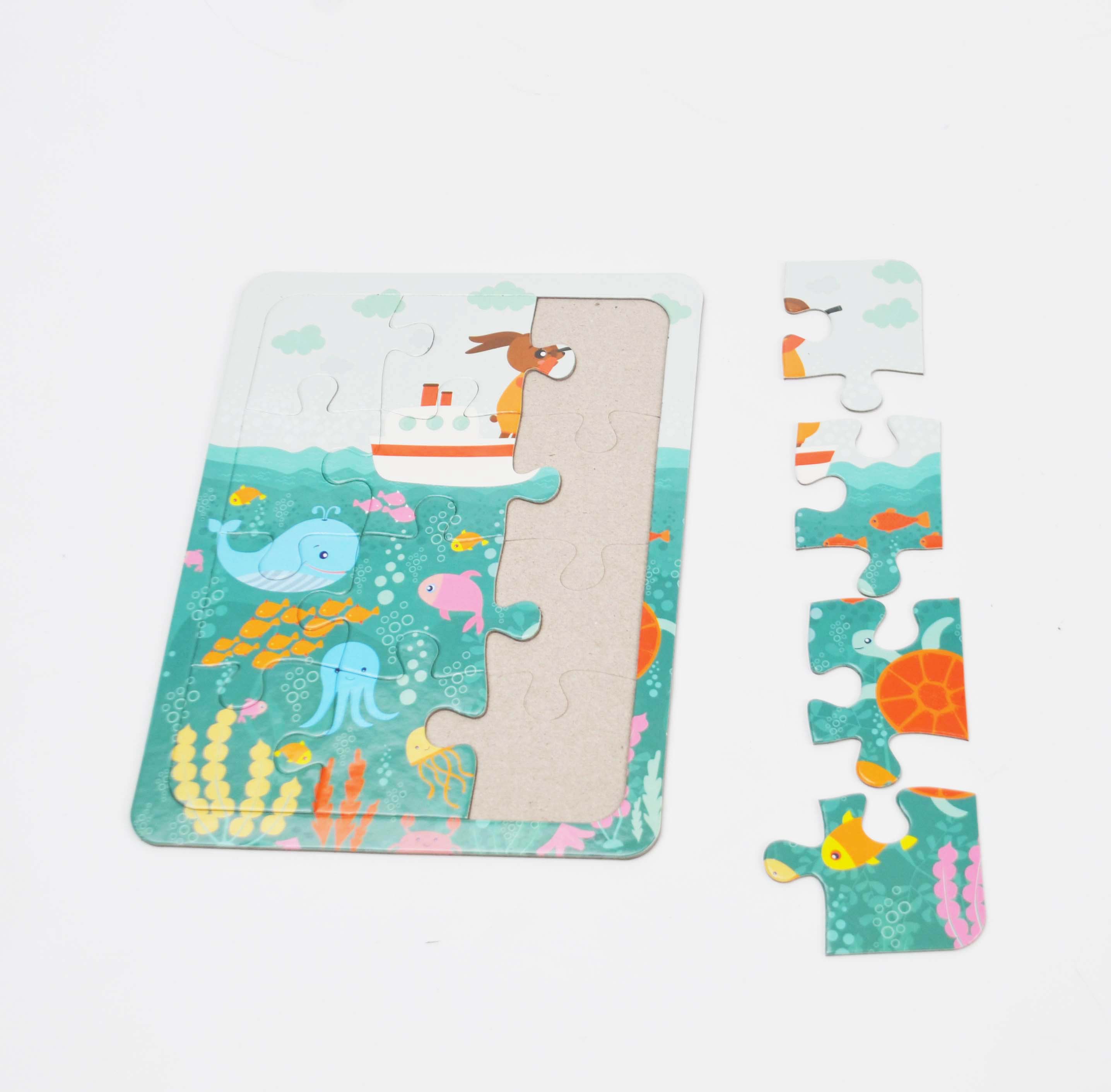
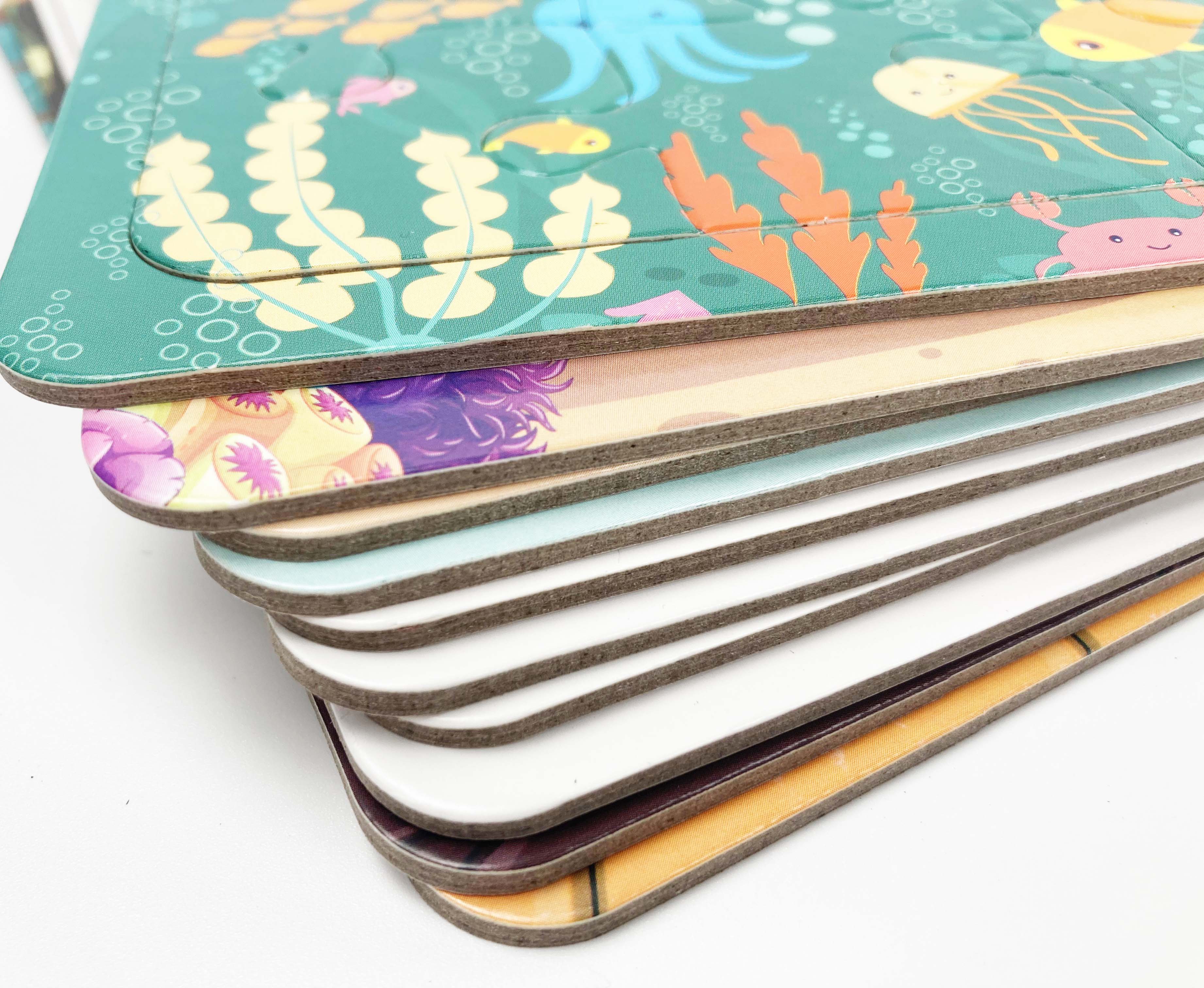
South Print also discusses double-layer puzzles, commonly around 3 mm for the completed structure. Some previous framed projects had a puzzle area within a border and a supporting base; this is an example, not the layout of every double-layer puzzle. Confirm the actual structure in the project drawing.
Do not describe this simply as a conventional puzzle made from a thicker board. Identify the layers and the measurement location for the stated thickness. If the design has a frame, specify its border, supporting base and removable pieces separately.
For a double-layer sample, check the applicable features:
- The overall size and, if framed, the playable area inside the border.
- Any intended border width or artwork on a surrounding area.
- For framed designs, how removable pieces sit in the frame and can be lifted out.
- Whether the complete assembly lies flat.
- Edge condition and any visible separation between bonded layers.
- The fit of the complete product in its packaging.
Around 3 mm is a typical double-layer planning reference, not a fixed specification for every design or a measurement of each piece. Existing tooling and the proposed materials need confirmation before the order is finalized.
Promotional, Retail and Gift Uses Can Share Materials
There is no strict South Print rule that promotional puzzles must use one base material and retail puzzles another. Packaging often creates the clearer distinction.
A promotional project may prioritize its distribution budget; a retail or corporate-gift project may place more emphasis on presentation. Those priorities still need to be translated into an actual product specification rather than an automatic board selection.
Keep packaging and puzzle construction as separate quotation lines. See the retail, promotional and gift packaging guide for that part of the decision.
Approve the Finished Construction
Compare samples with the intended materials, finish and cutting process, or clearly record any substitutions. Check flatness, visible layer separation, cut edges, piece handling and assembly.
Do not approve the construction from an image of the printed face alone. For a framed product, check both individual pieces and the assembled frame. For a boxed puzzle, check the full packed contents.
Material names and thickness do not establish age suitability or regulatory compliance. Any such requirements must be handled separately for the actual product and destination.
Use our puzzle sample approval checklist for the wider inspection.
What to Include in Your Enquiry
Send the finished size, piece count, quantity per design, artwork, preferred face paper, base material, target finished thickness and surface finish. State whether the product is conventional or double-layer and include a drawing for the framed structure.
Add packaging requirements and delivery destination. Ask the supplier to quote alternatives against the same underlying specification instead of assuming a fixed price increase for a thicker or differently colored board.
Contact sales@southprintcn.com or WhatsApp. Start with the custom puzzle printing page for the product overview.
Frequently Asked Questions
Which base material does South Print use most often?
Greyboard is the most common. Blue-core board and white cardstock are also options to discuss, with the actual construction confirmed for the project.
Do 1.7, 2.0 and 2.5 mm refer to bare board thickness?
No. These common South Print references describe finished puzzle thickness. Confirm the base-board specification separately.
Are double-layer puzzles always 3 mm thick?
No. Around 3 mm is a common overall planning reference. Confirm the layer structure, measurement location and agreed thickness on the project sample.
Is blue-core board automatically better than greyboard?
No. A core name or color is not a complete quality specification. Compare the actual finished construction, flatness, edges and assembly experience.
Must retail and promotional puzzles use different materials?
No. There is no strict material division between these uses. Packaging often provides the clearer distinction, while the puzzle construction is selected for the actual project.