Short Answer
Start with who receives the puzzle, how they receive it and when it must arrive. A promotional giveaway often prioritizes the campaign quantity and cost per complete unit. A corporate gift often gives more weight to the artwork, message and opening experience. The uses overlap, so the brief should describe the actual recipient experience instead of relying on the word gift or giveaway.
Then agree the finished puzzle format, quantity per design, complete contents, approval process and distribution plan. A simple printed white-card folding box can be a practical packaging direction for a cost-focused promotion when it fits and protects the contents. A gift project may justify upgraded presentation, but does not automatically require an expensive box or a high piece count.
Define the Moment the Recipient Gets the Puzzle
An event organizer, a brand campaign team and a corporate purchasing team may all order custom puzzles, but their distribution needs can be quite different.
| Project situation | Decision to make first | What to put in the brief |
|---|---|---|
| Event handout | Will visitors carry it away or use it at the venue? | Complete-unit size, handout quantity and storage space |
| Promotional campaign | Is the puzzle a standalone giveaway or part of another purchase? | Campaign versions, handout locations and allocation by location |
| Corporate gift | Is it presented in person or sent to recipients? | Gift message, presentation priorities and delivery arrangement |
| Activity followed by a take-home gift | What must happen at the activity, and what goes home? | Intended activity, components and recipient pack |
These are planning examples, not claims about completed customer projects. Decide whether the aim is a brief interaction, a take-home activity or a keepsake. This helps the supplier propose a suitable format without guessing from a logo file alone.
Choose the Puzzle Experience Before the Box
A smaller piece count can be worth discussing for a brief activity, while a longer take-home puzzle may suit recipients who enjoy that experience. Piece count alone does not establish difficulty or completion time: finished size, image detail and the intended user also matter.
Do not select 1,000 pieces simply because it sounds more substantial. For a compact event giveaway, a different format may fit the intended use better. Likewise, a small puzzle can be a considered gift when its artwork and message are relevant to the recipient.
Ask the supplier to review existing die options against the proposed dimensions and piece count. Availability and suitability must be confirmed for the order. Our puzzle size and piece-count guide covers format selection in more detail.
Set a Budget for the Complete Delivered Unit
Provide a target budget range per complete unit or for the whole project. State whether it covers the product, samples, packaging, transport and delivery. A target unit price without those boundaries can produce quotes that are difficult to compare.
Describe one complete unit: the puzzle, its inner containment, the printed box, and any reference image, message card or other agreed insert. Then state the total quantity and the quantity of each design.
For a cost-focused promotion, request a simple printed folding box made from white cardstock as one option. A tuck top tuck bottom (TTTB) structure may be discussed when it suits and protects the filled contents during the planned handling. Confirm the fit and quoted specification rather than assuming it suits every puzzle or always has the lowest total cost.
For a corporate gift, identify which detail matters most to the recipient. It might be the artwork, a message card, the box presentation or a particular finish. Request the base configuration and the upgrade as separate options so the extra cost can be evaluated.
Reducing redundant components or unnecessary packaging volume may help the budget, subject to the actual specification. Keep the functions needed to contain, identify and protect the complete puzzle. For structural comparisons, see puzzle packaging for retail, promotions and corporate gifts.
Give the Artwork a Clear Job
Specify which image forms the assembled puzzle and which information belongs on the box or an insert. A campaign illustration, a place, a company milestone or an original design can give the puzzle a purpose beyond carrying a logo.
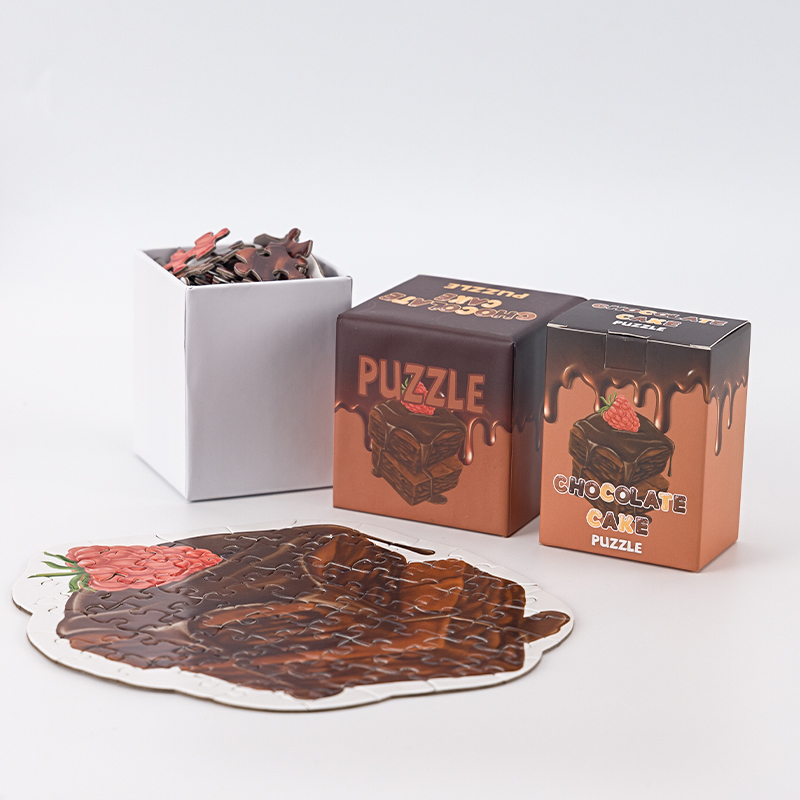
The chocolate-cake puzzle in the product photo illustrates themed artwork carried through the puzzle and packaging. Use it as a format reference when discussing your own campaign; the pictured configuration is not a standard package for every order.
Check small text and important visual details at the actual finished size. Do not assume that a design that works on a large poster will remain readable on a small puzzle. Approve the image, crop, logo placement and message together.
For film, character or other third-party artwork, provide files you are authorized to use. A use-case example does not imply an affiliation with or endorsement from a named brand. Keep recipient-specific messages and artwork versions identified clearly in the approval record.
Work Backward From the Required Arrival Date
Give the supplier the date the goods must reach the receiving location, not just the event date. Include any time the organizer needs to receive, count, sort and move the goods to the venue.
Ask for a project schedule that includes specification confirmation, artwork review, any physical sample, buyer approval, production, packing and the agreed transport route. These stages need project-specific timing; an event date by itself is not a production commitment.
Name the person who can approve artwork and samples. Where several teams are involved, collect their feedback into one approved version. Late changes to the design, format or packaging should trigger a review of cost and delivery feasibility.
Use the puzzle sample approval guide to define what the approval covers.
Plan Design Versions and Delivery Splits
One campaign may require several artworks, languages or event locations. Make a table linking each design code to its quantity, box artwork, insert and receiving location. If cartons contain mixed versions, define the quantity of each version inside.
Different designs may sometimes share printing or cutting setup, but the conditions need separate review. Do not assume five designs at 100 units each have the same cost as 500 identical units. See ordering puzzles with multiple designs.
Distinguish a bulk delivery to the organizer from individual delivery to recipients. Confirm who handles each stage, what transport packaging is required and which costs are included. Individual address fulfillment should not be assumed to be part of the factory quote.
If the audience includes children, state the intended users and destination market early so the relevant product requirements can be reviewed. A promotional label does not itself determine age suitability or compliance. The US and EU puzzle safety guide covers that separate topic.
Send a Brief That Can Be Quoted
- Purpose, intended recipients and handout or gift-delivery method.
- Required arrival date, destination and receiving arrangements.
- Quantity per design and total quantity.
- Finished size, piece count and material preferences, or open choices needing recommendations.
- Target budget range per complete unit or for the whole project, stating whether it includes the product, samples, packaging, transport and delivery.
- Artwork status, messages, design versions and approval contact.
- Complete contents, packaging direction and preferred upgrades to compare.
- Carton allocation, delivery splits and any target-market requirements.
Ask for a clearly described base option and one relevant alternative. For example, compare a campaign puzzle in a simple folding box with the same puzzle plus an upgraded gift presentation. Confirm the exact inclusions before choosing between the prices.
Send your brief to sales@southprintcn.com or WhatsApp. Explore our custom jigsaw puzzle printing service for the product options to discuss.
Frequently Asked Questions
What is the difference between a promotional puzzle and a corporate gift puzzle?
A promotion often prioritizes campaign quantity and cost per complete unit, while a corporate gift may prioritize presentation and the recipient message. The uses overlap, so define the audience, budget and distribution plan for the actual project.
Does a corporate gift puzzle need 1,000 pieces?
No. Choose the format for the intended activity and recipient. Finished size, image detail and user experience matter alongside piece count; a higher count is not automatically a better gift.
Can a promotional puzzle use a simple folding box?
Yes, it is a packaging option to discuss. Confirm the structure, filled contents, handling and protection requirements. A TTTB folding box is not a universal fit for every puzzle specification.
When should we start planning an event puzzle order?
Share the required arrival date as early as possible and ask for a project-specific schedule covering approvals, samples where needed, production, packing and transport. There is no single lead time that fits every order.